Distance: 18 mi. out and back Elevation gain:1322 ft
This is the only ride in Bestrides that’s mostly dirt.
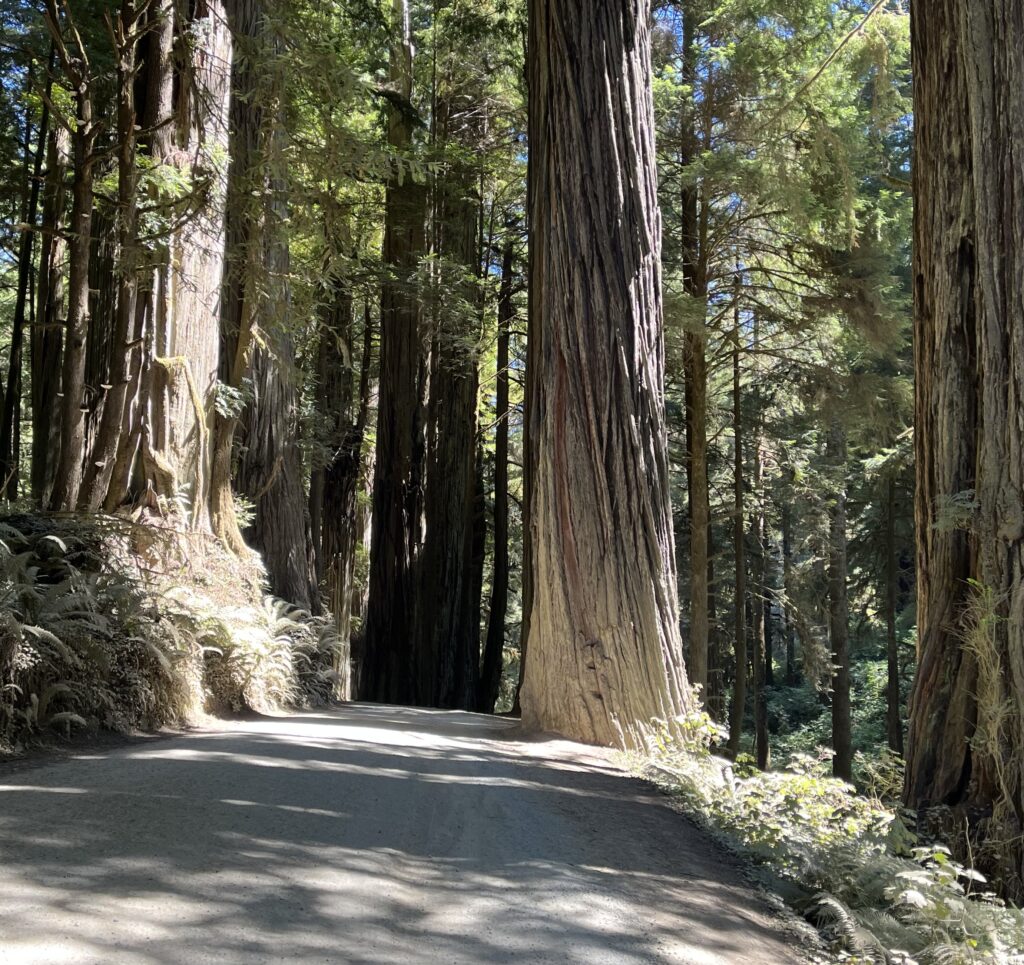
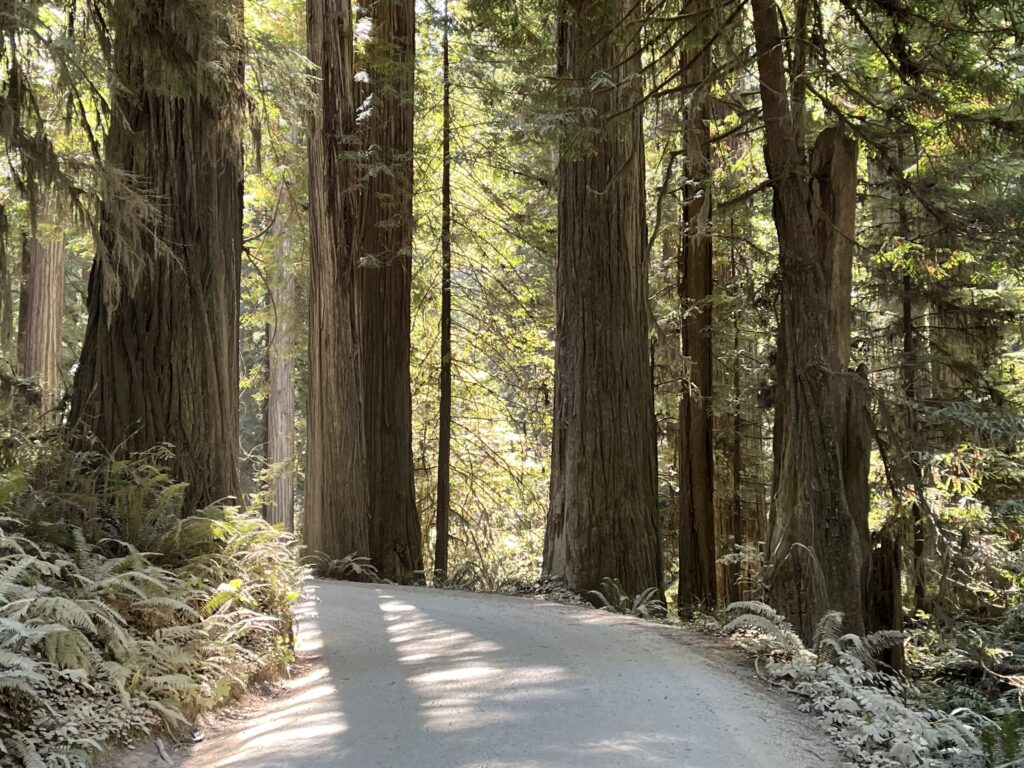
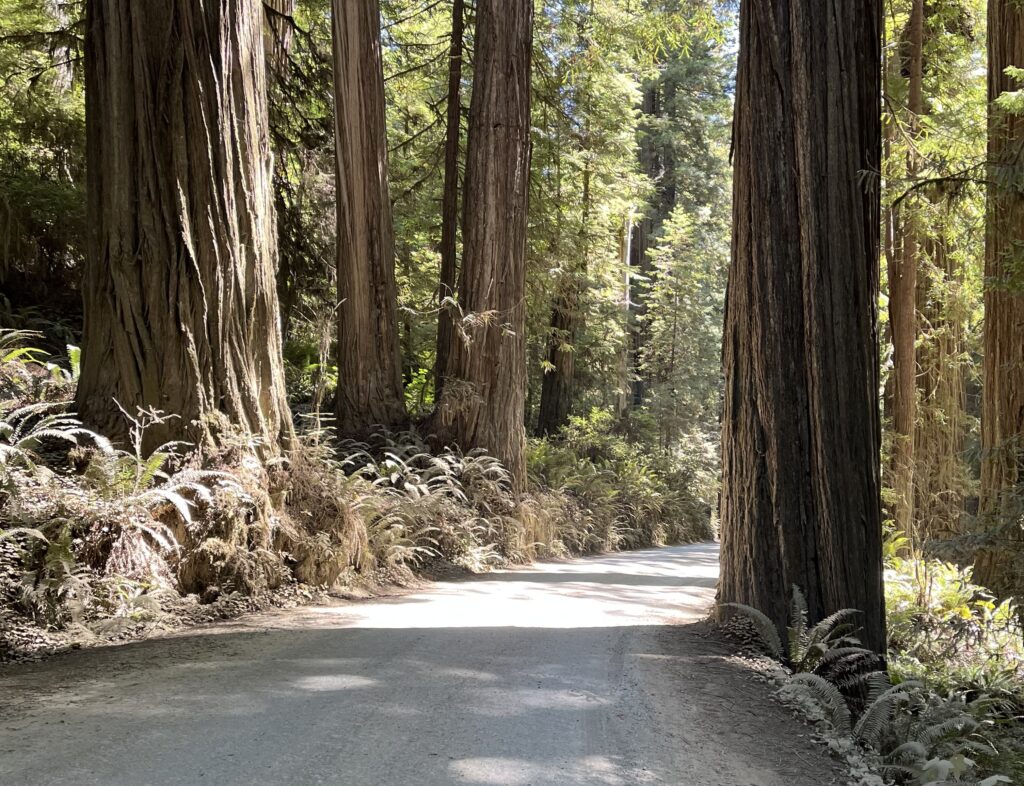
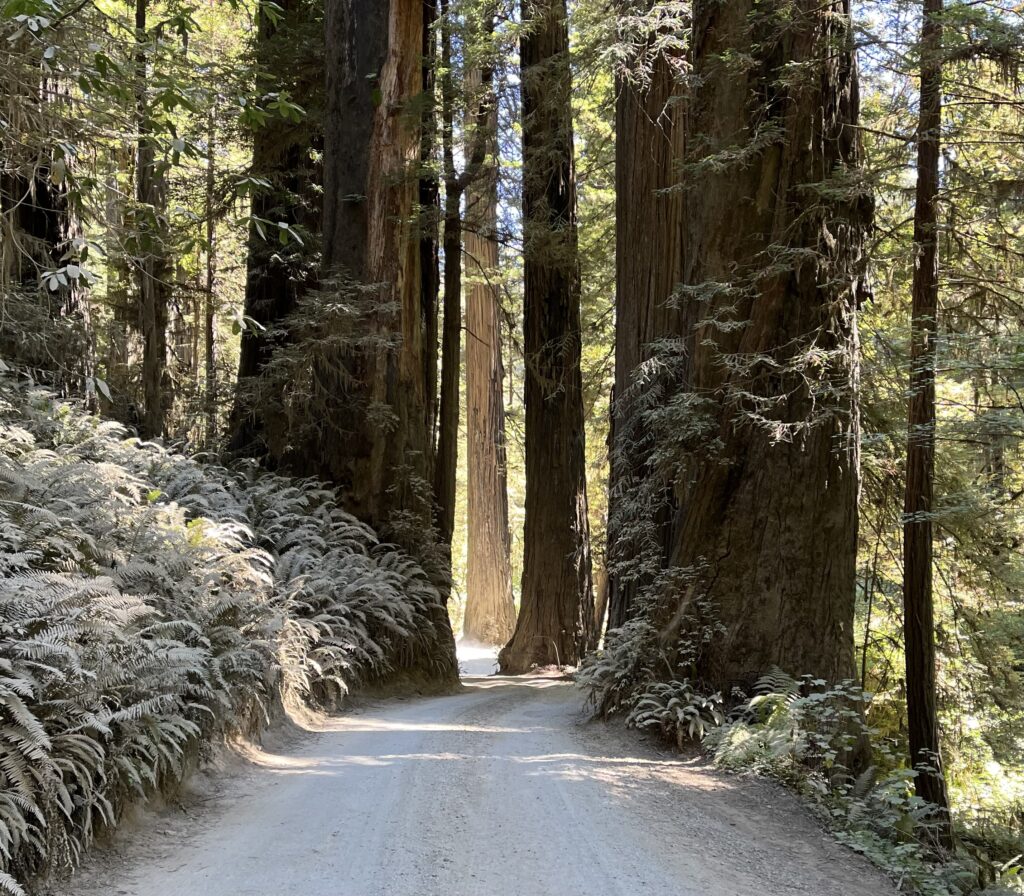
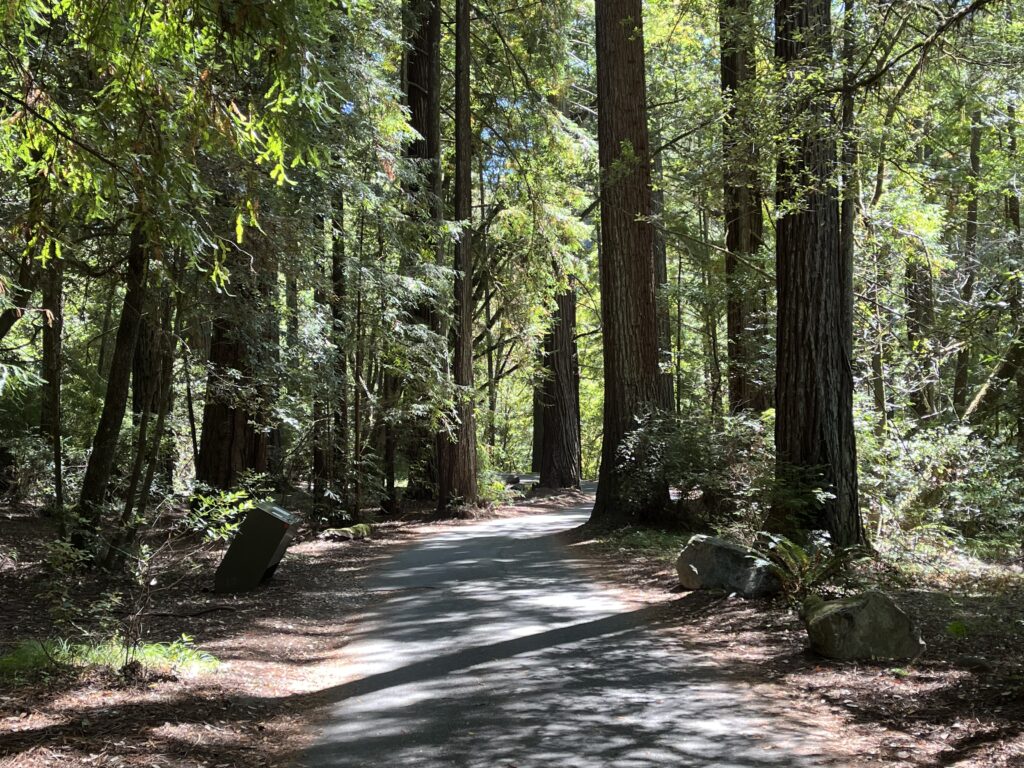
Once upon a time there was a sweet little dirt road that wound through the backcountry redwoods of Jedediah Smith Redwoods State Park. It was a chance to get up close and personal with the big trees without the hordes of people jammed into the campgrounds and the famous groves.
Then a terrible thing happened: the State Park decided to promote the hell out of the road. So now there’s a large billboard along the highway encouraging cars to drive it, the local visitor’s center has a large sign advertising its virtues, and the guides at the visitor’s center tell everyone who comes in that they should drive it.
So now in the summer it’s a zoo. Constant traffic in both directions. Cars bumper to bumper. When I did this ride, I saw perhaps 300 cars on the road in 18 miles. I counted 47 cars parked at one of the trailheads. I spent almost the entire ride inhaling the dust of passing cars. The trees and bushes were blanketed with dust.
BUT if you can ride it when the traffic is gone, it’s a unique and splendid experience—the closest you can get to the redwoods on a bike. Just check out the photos in this post. Certainly the second-best redwoods ride in Bestrides, after the Avenue of the Giants. To escape the traffic, all you need to do is: 1) wait until tourist season is over; 2) ride on a weekday (I rode on a beautiful Sunday midday in August—worst possible time); and 3) wait until the region has gotten at least one good soaking rainstorm, to wash the dust from the flora. Obviously you don’t want to ride a dirt road right after a lot of rain, but the road is rock, so a little wet won’t hurt the riding at all.
There are stout gates at both ends of the road which look like at some time they would be closed. I don’t know when that would be (or why), but if you’re planning on a winter ride, check to make sure the road is open.
The ride is basically flat, with a noticeable mile of up and a mile of down at the west end (the “hill” in Howland Hill Rd.). The ride is easy, and the dirt surface is in good shape, but it’s still a rocky road, so a gravel bike is essential. I think the road surface improves as you go west, but I may have just been getting used to it. You can avoid a lot of the road chatter if you ride on the extreme shoulder, but redwood country is poison oak country and you may be getting into it by doing so.
You can start at either end. In theory you could loop it, but it would involve a lot of riding on Hwy 199, where you’re really not welcome.
Park at the intersection of Hwy 199 and South Fork Rd. There’s a large parking lot there (and the large sign advertising Howland Hill Rd.). Ride SFR (briefly) to Douglas Park Dr., which soon turns into Howland Hill Rd. and becomes dirt. Ride HHR to the summit, where it turns back into pavement. You get a very nice mile of descending down to the flats of the Crescent City outskirts, At the intersection of HHR and Bertsch St. you can see ahead of you that HHR goes straight and flat, so turn around and ride back to your car. The paved mile of climbing back to the dirt (some 9-11%) will be the only real work you do on the ride.
I am now going to tell you to do something that will convince you I’m bats if this post hasn’t done that already. Throw your bike in your car and drive the couple of miles westward to the Hiouchi Visitor Center and park. Get on your bike and go ride all the roads of the Jedidiah Smith Campground across the street. It’s about 2 miles total. It’s wonderful—a fairy land of paved paths through pristine forest and almost no traffic. It’s a perfect cool-down.
Shortening the ride: You could turn around at the Howland Hill summit, but you’d be missing a swell little descent.
Adding miles: At the turn-around you can keep going and ride into Crescent City. It isn’t great riding, but riding out of the redwoods through a back door into a city has a certain mystique, and Crescent City is a nice, rough-and-tumble working-class coastal town.
At the intersection of South Fork Rd. and Douglas Park Rd. at the very beginning of our route, if instead of turning R onto DPR you go L and stay on SFR you can ride for miles on what appears to be a well-maintained two-lane road through mostly uninterrupted woods. When SFR ends, it turns into what Google Maps calls “G-O Road” but is in fact Gasquet-Orleans Rd,, a rougher track about half South Fork Rd’s size that runs for miles, also through uninterrupted woods. Both roads together total 31.5 mi. one way. They’re both covered by Streetview. I haven’t ridden them, but they look good.
Distance: 13.5-mile out and back Elevation gain: 460 ft
This is possibly the easiest, most low-key ride in Bestrides. It’s short and essentially flat. It’s a haven for casual riders on rental cruisers, and the population of walkers and their dogs on leashes is high.
So why is it in Bestrides? Because it’s the only place I know of where you can ride your bike on a paved trail along the magnificent Northern California headlands and watch the waves crashing against the seastacks below you, the harbor seals basking on the rocks, the pelicans heading in single file to their mysterious destinations to the south or north, and the seagulls wheeling overhead. It’s more a meditation than a ride, and I love it. In addition to the natural wonders of sea and headland, the ride offers a grand old wooden railroad trestle, a world-famous bridge across the Noyo River, a postcard-perfect beach and wooden boardwalk across marshes to Seal Rock (both in MacKerricher State Park), a second beach composed of glass pebbles, a marine biology interpretive center, enough informational placards scattered along the path to satiate the most info-hungry among us, and Fort Bragg’s state-of-the-art water treatment plant.
It’s a mere 13.5 miles, but you can’t ride it fast (too many walkers), and you want to enjoy the ambiance, so it’s a solid one-hour ride.
This ride traverses the shoreline just to the west of Fort Bragg. In past years the riding here consisted solely of the Old Haul Road, a rail-to-trail conversion that ran from about a mile north of MacKerricher State Park a few miles north of town southward until it crossed the grand trestle spanning Pudding Creek at the north edge of town. It was a mostly straight, fairly boring ride on poor pavement, worth doing once for Mackerricher itself and the simple joy of being on a bike by the sea. But in recent years the massive lumber mill complex that occupied the entire west side of the town, everything between Hwy 1 and the sea, was torn down and carted away, the land was turned into Noyo Headlands Park, and our lovely trail was cut along the lip of the cliff from the south end of town to the north and connecting to the Old Haul Road.
The trail itself isn’t all eye candy. Much of the time you’re riding through open grassland, with the good stuff—the lip of the cliff and the crashing waves below—out of sight a short distance to the west. But the trail has a nice meandering contour, and it’s usually only a matter of hiking (or illegally riding) 30 ft off the trail to get those matchless vistas.
The main southern trailhead, with bathrooms and maps, is at the west end of Cypress St., but you don’t want to start there. Instead, drive to Pomo Bluffs Park on the south side of Noyo Bay. This allows you to ride the leg of the trail along the south side of the Bay and cross the Noyo River Bridge. The road surface here is a little rough, but the views of the bay are great (you can see the trail continuing on the northern shore), the informational placards are interesting, and you’ll have the trail to yourself. Be sure to read the placard detailing the history of bridges over the river (there have been several) and the multiple awards the current bridge has won.
Pomo Bluffs Park, looking across Noyo Bay to the next leg of our trail
Cross the Noyo River Bridge on the clean and comfy separated bike lane and immediately pick up the trail (unsigned, but it looks just like a trail, with a bollard and a “mi. 0” painted on the pavement) at the north end—oddly, the mileage markers seem to go to 1/2 mi. and stop). Btw if you’re riding the trail backwards, picking up the trail at the south end of the bridge is challenging. It begins in the parking lot for the Noyo River Grill and wraps tightly around the back side of the restaurant. The trail entrance is small and looks like a back entrance to a trailer park.
Back on our mapped route, ride to the southern trail head parking lot, where there are bathrooms and a large map of the Noyo Headlands Park area informing you that you are on the Ka Kahleh Trail. The Pomo Indians were centrally involved in the development of the area, and you’ll see their influence throughout the ride—most notably on a harrowing trailside placard detailing the awful treatment they received at the hands of the white settlers.
On the otherwise-impeccable map, the trail is shown to have a large gap in its center. This seems to be old news—the trail is now flawless pavement all the way to Glass Beach.
Trailside scenery is a bit bland away from the water
The bathrooms sit at the southern end of the old sawmill airplane runway, unmissable and open to cars and bikes if you’re of a mind to do some dead flat, dead straight riding. Take a moment to imagine what it must have been like to land a plane alongside the cliffs on one of those typical Fort Bragg days with heavy fog or strong crosswinds.
Immediately past the bathrooms is a grand sinkhole on your L, Skip’s Punchbowl. For the best views, get off your bike and walk around it.
Halfway down the trail you encounter the Noyo Center for Marine Science’s Crow’s Nest Interpretive Center, complete with exhibits, tours, and a 73-ft whale carcass made from dirt. Well worth a stop.
At the northern end of the trail you pass the steps to Glass Beach, a local mecca. The beach was used as a dump for glass bottles for decades. The surge smashed the bottles and wore the shards down to smooth beads. Worth a visit if you like colored glass. You’re asked not to remove samples.
At the northern end of the trail you pass the Glass Beach parking lot. At its eastern end (by the bathrooms), take the bike path north to the Pudding Creek Trestle and cross it.
From the Coastal Trail looking back at the Noyo Harbor entrance and the Noyo River Bridge
From here to MacKerricher State Park you’re on the Old Haul Road. It’s straight- er, rougher of road surface, and much less scenic than what you’ve already ridden, and if you want to turn around so be it, but I encourage you to persist, because the OHR takes you to MacKerricher, which is a lovely spot. Once there, gaze at or walk on the pristine beach and walk the wooden boardwalk out to Seal Rock for a grand view of the coastline. The park is free to everyone—when the MacKerricher family gave the land to the State they mandated that no one would ever have to pay.
The trail debouches on to the MacKerricher main road, and you’d think it was over, but there’s more. Ride north 100 yds on the road and pick the trail up again. It continues north amidst the sand dunes for a mere 1.2 miles (clearly marked on our map as MacKerricher State Park Road, but not included in my route map), at which point it ends at a nice overlook of 10 Mile Beach and the stretch of California coast to the north. It’s short but it’s worth doing for its proximity to the beach and the (relative) solitude.
Retrace your steps.
Shortening the ride: Hard to imagine wanting to, but the plumb miles are clearly those between the sinkhole and Glass Beach.
Adding miles: A sweet little loop that actually touches our route is
I know of no other good riding in Fort Bragg proper. Our Mendocino Coastal ride is 15 minutes to the south in Mendocino. See the Adding Miles notes of the Mendocino/Comptche ride for good riding further afield.
Hwy 1 north of Fort Bragg from town to Ten Mile Beach is a particularly beautiful stretch of Hwy 1, but it’s very trafficky and without shoulder.
Distance: 29 miles one way Elevation gain: 3890 ft
(A Best of the Best ride)
There are three routes to get from the Mendocino coast to the Lake Mendocino area of Hwy 101: Hwy 20, Hwy 128, and this one. They couldn’t be more different. Hwy 20, from Fort Bragg to Willits, is gorgeously wooded but a death-trap for bikes, a heavily-trafficked road of blind corners and no shoulder. I’ve never seen a bike on it, for good reason. Hwy 128 and Hwy 253, from Albion through Boonville to Ukiah, a leg of which is part of the Mendocino/Comptche ride, is mostly a mellow, nearly flat cruise through domesticated farmland and riparian redwoods. Our route (called at its west end Comptche-Ukiah Road and at its east end Orr Springs Road, with a name change somewhere in the middle) is a different beast, a dramatic, demanding roller-coaster. It’s one of the best rides in California, constantly serpentining and climbing up and down (it’s never flat) through several kinds of pretty-to-gorgeous terrain on an almost-car-free road (I met perhaps 10 cars) that ranges in size from small two-lane to tiny.
There are two drawbacks that may keep it from being your favorite ride. First, it’s too hard as an out-and-back for all but the hardiest of riders—57 miles and 7310 ft., with 12 miles of demanding climbing. So I’ve mapped it as a one-way ride. In the Adding Miles section below I’ve suggested some possible return routes. Ironically, my favorite 4 miles of the route are the miles just east of Comptche, but riding west, an absolute hoot of a descent which you don’t get to do as I’ve mapped it (see Shortening the Ride below).
Second, most of the road surface is OK to great, but 4 miles are in poor shape, and they’re 4 miles that matter—the 4-mile descent into Ukiah, which could be a ripping descent but now are a jar-fest.
Besides 30 miles of exhilarating road contour and beautiful isolation, the route offers two fine perks: Orr Hot Springs, a small, charming Hippy holdover, and Montgomery Woods State Natural Reserve, a fine stand of old-growth redwoods with a short loop trail. Each is well worth an hour’s stop-over.
All but 6 miles of the ride are mellow meandering up and down or blazing descending, but all the hard work is in that 6 miles—a two-mile climb about 2 miles into the ride and a four-mile climb right after Orr Hot Springs. Those two climbs make this one of the hardest 29-mile rides I’ve ever done.
The ride is about as good in the other direction, and through-riders might like to use it to get from Hwy 101 to Hwy 1 and Mendocino, but don’t think that just because it’s going west from the heights of the Coast Range to the ocean it’s all down—it’s 3420 ft of gain going west, only slightly less than the gain going east, and the ups are steep.
There is no water source along the route except a few private houses and Orr Hot Springs, so plan accordingly.
Start in the tiny town of Comptche, which consists of a few houses, a rustic school, a rustic church, and a classic, friendly corner mercantile worth a visit (when it’s open, which in 7/23 was every day but Sunday). Head east on Comptche-Ukiah Road, the only road that isn’t Flynn Creek Road. After a short 2-mile warm-up on rollers, you do a vigorous 2-mile climb on 7-11% pitches. The road surface, recently redone, is glass from Comptche to around Mile 7, then merely good to around Mile 10. You’ll have some town traffic in the first mile or two, but soon the houses and farms end and you should have the road pretty much to yourself for the rest of the ride.
If you’ve ridden the Mendocino/ Comptche ride route from Hwy 1 to Comptche, you know how drop-dead gorgeous the woods are there. East of Comptche the climate is a little dryer, so instead of redwood rainforest you get oaky woods, but it’s still lovely.
At the fairly noticeable summit the road begins to roll up and down (as I say, the route is never flat) for about 5 miles. You begin hitting short sections of road with poor pavement, but they’re interspersed with sections of new glass, and it never gets troublesome. Then you see a sign that reads “next 2 miles, 10% (down)” and you begin about 2 miles of serious descending, 10-15%, which is one of two compelling arguments against riding the route east to west (the other being the 4-mile climb at the east end).
It isn’t my favorite descent in the world. It’s too steep to be liberating, and as of 10/26 there’s so loose gravel, but it’s been repaved recently so the surface is now good. Big tires and disc brakes are a good idea.
At the bottom of the descent you begin a 7-mile stretch of gradually rising rollers, the nearest to flat on the route. The scenery, which was always lovely, gets better as you hit a wetter microclimate, and soon redwoods reappear and you’re in paradisial forest. The road contour is lovely, a gentle meandering up and down and back and forth. Most of this road surface is un-ideal chipseal, but it’s not bad enough to ruin your wa.
When the redwoods reach their peak you hit Montgomery Woods State Natural Preserve (unmissable on your R), a lovely short walking lollipop trail through the best of the trees. Bikes are forbidden, and it’s a bit of a climb to get to the loop of good trees, but you can still stop, sample the ambience, read the historical placards, and use the bathrooms by the entrance.
The road, which was always small, has been getting smaller (the center line is long gone), and right after Montgomery it gets laughably narrow. Enjoy it—it will return to normal two-lane width soon enough.
You may see walkers along the road here, because Montgomery is a mile or two down the road from the route’s other plum, Orr Hot Springs (unmissable on your R). This small but developed hot springs has nothing in common with big operations like Harbin Hot Springs or Wilbur Hot Springs. It’s usually almost deserted, which is good because the hot springs can only handle about 4 people at once, consisting merely of a large roofed barrel and a shallow, rocky puddle. The expansive flower gardens are an unexpected but joyful draw—walking among the blooms is as restorative as the hot water. It’s all very peaceful and solitary. Consider begging for water here, because you have 12 miles of hard, exposed, and potentially hot riding still to do.
Immediately beyond Orr, the route begins its most demanding climb, 4 miles of tough pitches that for the first 2 miles are brutal. Those first two miles are probably never over c. 12%, but they’re also never much below 10%, and it wears on you. After the first two miles it’s just standard hard, 8-10%. To make matters worse, when the climbing starts, the terrain changes, from lush redwood canopy to open, grassy hillsides with the occasional spot of oat-tree shade, so if you’re riding on a summer afternoon expect to be cooked. When I started in Comptche it was 55 degrees—on the big climb it was 95. The good news is that, as the climbing starts, the road surface turns to glass.
At the top of the 4-mile climb, the laborious climbing is done for the ride.
This new rolling grassy landscape lasts until the end of the ride, and it’s really quite rewarding in its way, with a lot of serpentining in the road contour and lots of big vistas in all directions. For the first time in the ride, you can see more than 30 yards of the road ahead of or behind you. At times you can see all the way to the coast behind you, about 40 miles.
Looking west at the road behind you from east of Orr Hot Springs
At mile 21, you start the big descent, 4 miles of spectacular dropping down along the sidehill of a canyon. I had the highest of hopes, but I didn’t like it at all. The road surface is poor, so you find yourself getting seriously beaten up and spending all your time looking for the least jarring lines through the broken pavement, and the pitch is so steep you have to brake constantly and hard to keep from being beaten to death and/or thrown off the road. Again, disc brakes and fat tires may mitigate the worst of this.
Typical terrain for the last 8 miles
Once off the hill, you roll under Hwy 101 and T into North State Street just north of central Ukiah. Here there is nothing but some commercial/ industrial activity, and here I abandon you to look for a way home.
Shortening the ride: You can turn around any time. The first logical turn-around spot is at the first summit—round trip distance 8 miles but it’s a demanding 8 miles. It’s a splendid, class-A descent, with great pavement, good sight lines, and gentle turns that don’t require much braking. East from the summit it rolls for about 5 miles, so you can continue on without a major climbing penalty and turn around at the “Next 2 miles, 10% (down)” sign—round trip 17 miles. Beyond that point, you’ve got a rough and tough 2-mile climb coming back, so continuing is an investment.
Adding miles: Obviously the simplest extension is to turn around and ride back the way you came, which of course doubles the distance and almost exactly doubles the climbing effort. The two major climbs you encounter heading west are both daunting. If you don’t like out-and-backs and are willing to put in a very long day, you can loop the route, and it’s almost all great stuff: from our end point, go south, through Ukiah proper to Boonville-Ukiah Road, take BUR, go R onto Hwy 128, ride 128 to Flynn Creek Rd. and take Flynn Creek Rd. back to Comptche—80 miles, 8340 ft gain (so it’s easier than the out-and-back route, since it’s a little more climbing spread over a lot more miles). All these legs except for the few miles through Ukiah proper are discussed in other Bestrides posts (you can search for them) and are top-quality miles.
If you want to keep the return miles to a minimum but don’t like out-and-backs, there is a mythic road that will take you almost straight back to your starting point: Masonite Road. It takes off from Orr Springs Rd. just outside Ukiah and wanders around until it rejoins Hwy 128 just east of Flynn Creek Rd. It’s 35 miles, 3070 ft, so it’s a much easier ride than Comptche-Ukiah/Orr Springs Rd. in either direction. Here’s a map. My sources tell me it’s officially a “private” road and gated off to cars but bikes are welcome. Google “Masonite Road” for more details. It sounds dreamy, except for one thing: it’s 75% gravel, so it’s not for me.
Distance: 26 miles out and back Elevation gain: 1600 ft
I’m not a fan of cycling Highway 1. The scenery is peerless, but the traffic is often murder and the road profile tends to long, straight, enormous rollers. But in some places there are frontage roads paralleling Hwy 1, and these can be charming, with all the pluses of Hwy 1 and none of the minuses.
One of the best places to explore back roads along Hwy 1 is Mendocino. This ride strings together the best of them, and adds a pleasant climb and a final short jaunt on excellent dirt through prime woodlands. It’s all easy riding, and the scenic riches almost defy description. In a brief 12 miles are packed grand ocean vistas, the world-famous village of Mendocino, the also-world-famous Mendocino Headlands, a delicious State Park with fern canyons and more world-class headlands, some pretty coastal farmland, a sea lion rookery, an adorable lighthouse, a small cove with its own beach and 50’s beach store, and the afore-mentioned woodlands. To tie all this together you ride two short stretches of Hwy 1, both with grand ocean spectacle to the west if the traffic whizzing past you will let you appreciate it.
This is not a life-changing ride but an extremely pleasant one. There are at least 5 spots along this route where getting off the bike and walking is almost mandatory, so take shoes and a lock, or promise yourself you’ll come back in a car.
(This map has you riding out to the lighthouse in both directions.)
You can cut this ride up any way you like or begin anywhere you like. I’m starting at the southernmost point of the route. Drive a half mile or so south of Mendocino village, across the bridge over Big River and past the Comptche Ukiah Rd turn-off, and turn R onto Road 500B (named after Jedediah 500B, an early explorer and trapper). Googlemaps and other maps call it Brewery Gulch Road, but it’s clearly signed “Road 500B” at both ends. Make sure you’re on the Brewery Gulch Road that’s on the west side of Hwy 1—there’s one on the east side too. Parking can be scarce—you might have better luck on the east side of Hwy 1 or on Hwy 1 itself, or just ride from Mendocino village.
Brewery Gulch Road, our first frontage road, is less than a mile long and has a rough road surface, but the sense of being alone on a secret road is intense and it has the best view of the town of Mendocino there is—better than the view all those hikers get pounding around the Mendocino Headlands.
Mendocino village from Road 500B
Quickly Brewery Gulch deadends at Hwy 1 (notice our Mendocino/Comptche ride is directly across the highway). Turn L on Hwy 1 and ride across the bridge to Mendocino, enjoying the views of the Big River estuary if traffic allows. A dreamy way to pass a day is to rent a canoe at the canoe rental place at the mouth of the river and paddle upstream. Take the first L into the village (from Hwy 1 you can’t see the town, but the turn is unmissable) and ride along Main Street, quite possibly the most charming Main Street in the US. There’s a nice public bathroom on the ocean side of the street if you already need one, and a great little museum in the building adjacent to it. Consider taking the time to explore Mendocino’s world-famous vibe (Main Street’s book store, the Gallery Book Store, is my favorite book store anywhere), or just make a note to come back and spend a day.
When Main Street goes R, go with it and ride the 3 or so blocks to Little Lake Road. Turn L (toward the ocean) on LLR, which once out of town becomes Heeser Rd. Heeser, like 500B, is fairly rough riding but the headlands on the ocean side are without peer. You have to get off the bike and walk 50 ft to see them at their best—ideally, walk out onto the fingers of land that jut out into the sea—or once more promise to return if you can’t stop now.
The Mendocino Headlands at sunset
Heeser deadends at Lansing St. Go L and ride Lansing to its deadend on Hwy 1. Go L on Hwy 1. This next leg passes through very pretty forest with some magnificent glimpses of shoreline to the west, but it’s invariably trafficky and can be a white-knuckle experience, especially on the bridge crossings where the shoulder disappears. It’s soon over, as you turn L toward Russian Gulch State Park (clearly signed). You’re crossing traffic here, and the cars are doing 60 mph, so exercise caution.
Twenty feet down your new road, it T’s, and the road goes L into the park or R onto Pt. Cabrillo Drive. We’re eventually heading R/north, but Russian Gulch is a stunning place. It encompasses both a rainforest canyon of redwoods and ferns with an easy walking trail along the creek that will heal any and all psychic wounds, and a chunk of headlands with all the grandeur of those in Mendocino without the hectic multitudes of sight-seers. Once again, make a note to return for a day (there is a fee) and head north on Pt. Cabrillo Drive.
Pt. Cabrillo Drive
Pt. Cabrillo Drive is the second of our frontage roads. It meanders through gentle rollers, past eucalyptus groves, small farms, turkeys, and deer. Midway along it, you pass the turn-off to the Cabrillo Point Lighthouse (or Light Station, as it’s officially called). It’s a half-mile detour, and you’re welcome to ride right to the lighthouse complex, which is extensive. There is the lighthouse itself, not a tall tower (since the land it stands on is high above the water) but a perfectly charming thing that’s still in operation, and lots of outbuildings, many of which—two museums, the lighthouse keeper’s cottage, and others—are open to visitors. The lighthouse has infrequent tours of the lens upstairs, but is mainly a very nice gift shop staffed by a knowledgeable docent. Once again, if you don’t want to stop make a note to return.
Point Cabrillo Light Station and museum
At its north end, Pt. Cabrillo Dr. goes through an unexpected, unmissable hairpin just before it drops to the beach. On the outside of the turn, turn L on S. Caspar Dr., ride about 1/4 mi., and turn R. onto Headlands Point Way (behind a large gate) to Caspar Headlands St. Preserve, an undeveloped but lovely postage stamp of a park sandwiched between residences and the home of Sea Lion Rock, a rookery where the sea lions are almost always on display. You’ll hear them long before you see them.
Caspar Headlands State Preserve, with the rookery on the farthest rock
The preserve is signed (on the gate), but you may think you’re unwelcome because there’s a lot of evidence that the locals would rather you went somewhere else. There is the gate across Headlands Point Way (there’s a person-sized gap for you to walk through), there is a “private drive” sign, and another sign that reads “Moving gate may cause death.” In other words, “Welcome, guests!” Ride 50 yards down Headlands Point Way to the turn-around, then cycle or walk the 50 feet of dirt path to the cliff’s edge. There is a tiny but delightful warren of footpaths along the cliff, and the sea lions are on a rock just offshore (further out at high tide). You should have the place to yourself.
Returning to Pt. Cabrillo Dr., swoop down to Caspar Beach, a throwback to an earlier time with a small RV park and a beach mercantile, with surfboard rentals and pool tables. It’s a cute spot, but there are much better beaches in the Mendocino area, so I recommend you soak up the ambiance and move on.
Approaching Caspar Beach from the north side
At Caspar Beach you’re at sea level. You now climb 720 ft to the turn-around point of the ride. Make the short climb back up to Hwy 1 and go straight across onto what the maps call Caspar Little Lake Road but which is only signed as Rd 409.
The Caspar Beach store
The first 100 yards of 409 are steep, but it’s the only steepness you’ll see on the route. Thereafter it’s a few miles of steady, easy climbing through pleasant but unspectacular greenery until the road turns to dirt. Even if you hate dirt, do not turn around—this is why you’ve climbed the hill. The dirt is glass—better than a lot of pavement—the road is flat, and the trees, while not old-growth, are especially lovely. I liked it so much I came back the next day and rode it again.
The dirt at the end of 409
At around the 12-mile mark, 409 T’s into Little Lake Road, the very same Little Lake Road you were on for 50 yards as you exited Mendocino village (it’s unsigned—there’s a sign that says “Mendocino Woodlands” with an arrow to the left). At this point you have a choice. If you go R on LLR it will descend steadily and drop you smack in the midst of Mendocino village. If you’re a loop person, go for it, but the road surface is poor and I didn’t enjoy it. So I prefer to turn around and re-experience all the lovely stuff on the outbound route a second time. It’s up to you.
Shortening the route: You can choose any segment of the route you like—it’s all good—but I’d recommend the Pt. Cabrillo Dr. leg.
You can ride south on Hwy 1 to Navarro Ridge Rd (see the Mendocino/ Comptche ride Adding Miles section).
There is little that appeals north of our route. At the turnaround point you can go L on Little Lake Road, but it just leads to a warren of dirt roads and never hooks up with anything of importance. Riding Hwy 1 north toward Fort Bragg isn’t rewarding.
Distance: 44 miles out and back
Elevation gain: 6030 ft
The position of Bestrides has always been, avoid Highway 1 like the death-trap it is. The traffic is constant, irritable, and staring out to sea, and there’s no room for you. But all generalizations have their exceptions, and there are stretches of Hwy 1 worth riding: the Chileno Valley Rd and the Muir Woods loops come to mind. And this stretch of Hwy 1, the northernmost, while still busy, is more than worth your time. It’s grand. It’s a lot of climbing (only about 2 of the 44 miles are anything like flat), and there is only one break in the forest wall, at the turn-around. But that one break is a stunning view of the Pacific Ocean, the forest wall is often primeval redwoods, and none of the climbing is brutal. The road contour is perfect for descending—endless serpentining, curvy enough to be exhilarating, not so tight that you’re constantly on your brakes, all beautifully banked for speed. And of course you can continue on from the turn-around point and ride as much of Hwy 1 as you want to.
There are two flies in this otherwise-blissful ointment. The first is traffic. It’s busy. But it’s less busy than almost any other leg of Hwy 1, because most tourists are interested in the stretch between Fort Bragg and Big Sur. And it’s nobody’s commuter route, so the drivers are not in a hurry. The real problem is construction equipment: any wet winter causes damage along Hwy 1, so most summers there’s a steady stream of gravel trucks going to and from the construction site(s). It’s not as bad as it sounds—there is little shoulder but room to pass—but if it bothers you you might choose to ride in the fall, when the construction is probably complete. Even so, I did this ride midday on a Monday in July, the road crews were busy, yet I did long stretches of riding the center line in solitude.
The second ointment fly is the road surface. It ranges from glassy to tooth-rattling chipseal. When it’s rough, it definitely takes the edge off the descending. When it’s smooth, there is nothing better.
There are no services on this ride, and a lot of climbing, so plan your water. Since it’s mostly downhill for the first 18 miles, you can carry extra water without a performance penalty and drop it partway in.
If you prefer loops to out-and-backs, there is a lovely one at the end of Adding Miles.
Begin at the intersection of Hwy 271 and Highway 1, 40 feet down Hwy 1 from Hwy 101. There is plenty of shoulder parking around the intersection. You’re going to descend briefly, then climb a lot, so you might like to warm up on Hwy 271, which is relatively flat, and shows you downtown Leggett—just follow the unmissable signs to the drive-through tree and keep riding (more on Hwy 271 in Adding Miles).
On the climb
Back on our route, head down Hwy 1, descending .7 miles to a metal bridge and climbing moderately through very pretty forest for 4 miles to a blissful mile of plateau riding with fragmentary views of the Hwy 101 valley through the trees. Then descend, sometimes mildly and sometimes vigorously, to the 18-mile mark. At mile 14.5 on the map it looks like you’re on the coast, but you won’t see the ocean until the turn-around point at Hardy Creek.
At mile 18 you cross the (signed) South Fork of Cottoneva Creek on an unmissable bridge. Google “Cottoneva” (also spelled “Cottaneva” on google and maps) for some interesting local history. The maps and road signs call this spot “Rockport,” but there’s nothing there except the bridge—I don’t mean “no services,” I mean nothing.
View from the turn-around
After the Cottoneva Bridge you have a fairly tough 2-mile climb, then a similar 2-mile descent. As you labor up the pitch, note the road surface—it’s glass, so the descent when you return is the best descending on the ride and worth the work you’re doing now. Drop down the other side and a short climb takes you to the ocean. Getting to the water would be a tough trek down a cliff, so don’t expect to cool your feet in the surf, but the views are typically breath-taking, unless it’s fogged in.
The ride back is a lot of climbing, and you seem to be with the majority of the traffic this way, but the pitch never gets nasty and there are two nice descents to reinvigorate you. The 2-mile climb up from the ocean is the worst of it. Don’t “just ride” the descent to Cottoneva Bridge—it’s the best 2 miles of descending on the route, so relish it.
You can rip these descents (this photo is looking uphill)
The usual weather warning for the Pacific Coast obtains: Always be prepared for wind, cold, and fog on Hwy 1. There can be a 40-degree drop in temperature from the start of the ride to the turn-around.
Shortening the route: There is no particular leg of this ride that stands out, but psychologically you’ll probably want to see the ocean, so drive as much of the route as you wish and ride to the sea.
Adding miles: From the turn-around spot you have 200 miles of Hwy 1 between you and San Francisco, all of it visually spectacular but plagued with traffic from light to ghastly. The first 36 miles, to Mendocino, are particularly gorgeous, with heavy traffic only from MacKerricher State Park on. If you can arrange a shuttle or you’re through-riding, the ride from Leggett to Fort Bragg is really a better ride than the one I’ve mapped because you don’t have to climb back up the hill.
At the trailhead, Hwy 271, which you may have ridden some of to warm up on, is 10 miles of very pleasant, fairly flat riding that parallels and crosses over Hwy 101—well worth riding.
Our Branscomb Road ride is only a few miles south of the turn-around on Hwy 1, which offers the possibility of a truly epic loop: Leggett to the sea, down Hwy 1 to Branscomb, up Branscomb to Laytonville, up Hwy 1 to Hwy 271, 271 back to Leggett—total 74 miles, with 17 miles on Hwy 101 to be endured:
Distance: 21 miles one way
Elevation gain: 2835 ft
This is one of seven rides (all detailed in the Adding Miles section of the Mountain View Road ride) that are worth doing around Boonville, a charming little town with good food and an interesting history, so I encourage you to find a place to stay in the area, make a cycling holiday out of it, and do all of them.
This road parallels Mountain View Road, which is 5 miles to the south, and the two are similar. Both roads are trips through standard coastal pine/redwood forest with a good dose of 8-10% climbing. This one is less isolated that MVR (a vehicle a mile or more), but it’s prettier and easier and it has a better road surface (though it’s still often poor). It makes for a shorter loop if you’re returning on Hwy 128, so if I was just doing one of the two I’d go with Philo-Greenwood unless I wanted a) a bigger climbing challenge, b) more Hwy 1 riding, or c) to visit Manchester. I’ve mapped the ride as one way because I assume you’ll want to return on 128, which is covered in the Mendocino/Comptche ride. The Philo-Greenwood/Cameron Road/Hwy 128 loop is 42 miles.
Begin riding at the intersection of Hwy 128 and Philo-Greenwood Road just north of Philo. The community of Philo is little more than an apple stand (Gowan’s Oak tree—can’t miss it, worth a stop for the apple juice), so you might want to ride from Boonville, 5 miles south of Philo, thus adding about 12 miles.
Philo-Greenwood Road
Head down PGR. Almost immediately you pass the turn-off to Hendy Woods State Park, a lovely stand of old-growth redwoods that charges a substantial fee. Just past HWSP, you begin a hard 4-mile climb, an unrelenting grind that averages 8% but is frequently 10-12%. Almost all of the hard work on the ride is right here. The forest is very pretty—prettier, I think, than Mountain View Rd., though the fact that I rode it after a rainstorm may be the reason. Watch for glimpses of the Navarro River watershed through the trees on your right. Right after the very first little downhill, at 3.5 miles, Signal Ridge Rd. goes off to the L—consider riding it (see details in Adding Miles).
When the bulk of the climbing is over, you roll pretty constantly up and down through more pretty woods, with pitches up to 8%, past scattered farms to the intersection of PGR and Cameron Rd, 15.2 miles in. The road surface, which in the beginning randomly varies from good to poor, deteriorates as you approach the intersection, until in the last miles it’s consistently rough.
At the intersection you have a clear choice. PGR plummets down to the sea (the intersection is exactly at the lip of the precipice, with a sign reading “10% grade (down) 2 miles”). Cameron, to the R, goes to the same ocean in over twice the distance (5.6 miles vs. 2.5 miles) and thus is half as steep. So stay on PGR if you want high drama and smoking brake pads, you want to see Elk (a tiny community with a good diner), or you want to ride the very nice stretch of Hwy 1 north to Hwy 128. Go right on Cameron if you want a relatively mellow and much straighter descent (15-25 mph). I’ve mapped it the mellow way. The road surface remains less than you’d wish but never awful.
Cameron Road
Cameron meets Hwy 1 about 1 mile south of the Navarro River bridge. Just south of the bridge, a paved road goes into Navarro Beach, a sweet patch of sand where the river flows into the sea. You’ll find interesting historical placards (it’s part of the Navarro Redwoods State Park), good sea stacks, and driftwood sculpture—well worth a detour.
Shortening the route: Unless you cut PGR drastically short, you won’t save much by turning around, because Hwy 128 is much easier riding that returning on PGR. I’d opt for the full PGR/128 loop.
Adding mIles: I fully expect you to return to Philo via 128, whose praises are sung in the Mendocino/Comptche ride. If you want to make an epic out of it, turn south at the west end of PGR and return on Mountain View Rd. For other rides in the area, see Adding Miles in the Mountain View Road post.
Three and a half miles into our ride, Signal Ridge Rd. goes off to the L and goes 1.5 miles before turning to dirt. I know it’s just 3 miles out and back, but it is a precious three miles I strongly encourage you to do—a true one-lane road that dips and dives deliciously through gorgeous woods on its way to the few cabins that live up the road.
This is the loop ride directly to the north of the King(‘s) Ridge ride—in fact the two routes share a few miles—so the question arises, how are they different, and which one should you ride? They’re very similar. They’re both great rides and serious efforts with much climbing. Each has one pleasant, tiny town near the beginning of the ride, then you’re totally on your own. The terrain and landscape are similar for both (pretty coastal hill country). Tin Barn/Annapolis is further from Santa Rosa, the nearest large population center, so it gets ridden less. TB/A has more redwoods, the climbing is spread out more, and the road surface is a quantum leap better though still flawed (for the rare good pavement in Sonoma County, see our Occidental Loop ride and Bohemian Highway ride). TB/A has rhododendrons in the spring, a few miles of pretty, mellow Hwy 1, some totally ridable dirt, and by far the harder pitch (1 mile of 15-20%). TB/A, unlike King Ridge, can easily be cut short if you overestimated your resources. If that sounds like I think TB/A is the better ride, I do.
The coast is always subject to fog and wind, and thus chill, even on the hottest days. The hills of Tin Barn and Annapolis can get very hot. So dress for a huge temperature swing. The last time I was there, it was 102 degrees on Tin Barn and 64 (and windy) on Hwy 1—a swing of 38 degrees. Also, plan your water supply before starting out—on a hot day, two water bottles may not be enough to get you from Ratna Ling to Stewart’s Point.
(The map erroneously shows the Hauser Bridge Road as dirt. It’s paved.)
Start at Stewart’s Point (not to be confused by you STNG fans with Patrick’s Point to the north), a tiny coastal community with a very charming general store where you can get root beer floats after the ride. Ride south on Hwy 1. I’m not a fan of Hwy 1 riding, but this is completely pleasant—charming, nearly flat, with easy passing lanes for cars and not too many of them. It’s not the extreme/sublime scenery of the Hwy just to the south, which is known as Dramamine Drive, but for that reason it isn’t dangerous and leg-killing.
FOB Brian on Kruse Ranch Road—note the excellent dirt
Ride the short distance to Kruse Ranch Rd. (labeled Krause Ranch Rd on the Sonoma bike map) and take it to the L. You’ll soon be in the Kruse Rhododendron Preserve, which is a treat during the spring bloom. The road surface is all dirt, but it’s easy on 25 mm tires, the scenery is that matchless coastal redwood and fern rain forest, than which there is nothing better on this earth, and the pitch is pleasant until you get to The Plantation (can’t miss it). From there it’s a rather steep pitch to the road’s end at Hauser Bridge Rd. Rear wheel traction can be a problem on skinny tires, but it’s over soon enough.
Annapolis Road
Turn L on Hauser Bridge Rd., and now you’re riding the King Ridge loop backwards. (RidewithGPS shows HBR as unpaved, but it’s wrong.) Stop at the drinking fountain thoughtfully provided for you by the monks at the Ratna Ling Retreat Center (past the front gate on the L) and fill up—there’s no water source between here and the end of the ride, and it can be hot in those hills.
Drop steeply down to Hauser Bridge and begin the climb up the other side, which is something you’ll tell your riding buddies about. For 1.1 miles it’s a constant 15-20% (RidewithGPS says it tops out momentarily at just over 21%); after that it’s just 10-12% for a while. It’s a extraordinarily difficult climb, and if you aren’t in shape for it it can drain you and make the rest of the ride miserable.
Annapolis Road
At the top of the climb go L at a fork onto Tin Barn Rd (the other fork is King Ridge Rd). The rest of the ride, with one exception, rolls constantly but never fiercely, so if the ride hasn’t killed you by now it probably isn’t going to. Where Tin Barn T’s into Stewart’s Point/Skaggs Springs Rd., go R for a brief stretch almost entirely consisting of ripping descent and go L onto Annapolis Rd, crossing the old metal bridge to do so. Annapolis Rd begins with the other demanding climb (nothing like Hauser Bridge—just standard hard), and from there to the end the climbing is never worse than moderate, though there’s a lot of it.
Hwy 1 is sweet and unthreatening here
All of Tin Barn and Annapolis is lovely riding—climbing and dropping and back and forth through standard coastal ridge meadows and woods. The final descent on Annapolis, down to the South Fork of the Gualala River paralleling Hwy 1, is grand. It would be world-class if the road surface were better, but as it is it’s still very good. I confess I ruined my carbon front wheel by overheating the braking surface with all the braking I had to do, but that’s rim brakes for you—disc brakes won’t have a problem.
Often along this stretch of coast there’s a killer climb on the other side of the Gualala River to get back to Hwy 1, but not here—the mellow little riser here is a pleasant surprise. Turn L on Hwy 1 and ride the few miles back to Stewart’s Point, hopefully with the northerly wind for which the area is famous at your back.
Shortening the route: You can cut the route in half by turning L instead of R on Stewart’s Point/Skaggs Springs Rd. and riding it to Hwy 1. It’s a lovely stretch of road, so you won’t be losing any beauty. You could also cut the route in half the other way, by riding just the Annapolis half of the route (Annapolis to Stewart’s Point/Skaggs Springs Rd. to Hwy 1). It’s probably equally hard in either direction. Some people ride just Annapolis Road, as an out-and-back.
Adding miles: Obviously you can add King Ridge to the route, since it’s contiguous, and if you’re up for that my hat’s off to you. You can add Hwy 1 miles by continuing south past Kruse Ranch Rd, enlarging the loop by leaving Hwy 1 at either Timber Cove Rd, Fort Ross Rd., or Meyers Grade Rd. (in that order heading south), all of which are much harder climbs than Kruse Ranch. Remember, Hwy 1 gets tougher and scarier as you go south.
You can ride Stewart’s Point/Skaggs Springs Rd. east all the way to Geyserville. It’s a standard test of conditioning for local racers, and it accumulates serious elevation gain. It’s also hot on a sunny day, since much of it is exposed, and not particularly pretty once you clear the coastal redwoods.
Soda Springs Rd, which leaves Annapolis Rd at the tiny community of Annapolis and turns to dirt at a gate in about 4 miles, is reputed to be a fine little out and back.
Distance: 50 miles out and back
Elevation gain: 8000 ft
(Note: all Boonville rides are made better if you can do them during the Mendocino County Fair, a classic old-school rural fair of great charm.)
This is one of seven rides (all detailed in the Adding Miles section below) that are worth doing around Boonville, a charming little town with good food and an interesting history, so I encourage you to find a place to stay in the area, make a cycling holiday out of it, and do all of them.
This ride is tough. It may be one of the two hardest climbs in Bestrides (the other being Gilbraltar Road). And the road surface is mostly shaky. And there are only two rather ordinary “views,” despite the road’s name—the rest of the time, all you can see is the greenery on either side of the road. The scenery is typical coastal forest—no better, no worse. So it’s mostly about bragging rights, the sense of adventure, and the two charming towns at either end. Philo-Greenwood Road just to the north is easier and prettier and has a better surface. Continue reading →
(Update 10/25: The one fly in the glorious ointment that is this ride used to be the road surface on Flynn Creek Rd. I’m happy to report that FCR has been resurfaced, and enough time has passed since the resurfacing that the chip seal is nicely smoothed over by car traffic. The surface is now near perfect, and Flynn Creek Rd. has gone from pleasant to splendid. The entire loop is now about 85% A-level surface and the other 15% (the western half of Comptche-Ukiah Rd.) is not a problem. JR)
This may be the prettiest wooded ride, mile for mile, in California. It is, by far, the Bestrides route that has elicited the most “Best ride I’ve ever done!” responses from readers. And it has the selling point of starting and ending in downtown Mendocino, one of my favorite places. It climbs and descents up and over a summit among simply perfect piney woods, passes a classic country store, descends gradually along the Navarro River and its stunning riparian redwoods, and ends with a pretty but trafficky leg on Hwy 1 that’s thick with charming inns and one State Park to stop and explore.
It’s a fairly easy 46 miles (check out the distance-to-elevation-gain ratio above), but it’s never boringly flat and you still get two fine descents (if you’re going clockwise).
It’s hard to decide which direction to ride the loop in. See Which Way to Go below for the comparative virtues of the two directions. I’ve arbitrarily picked the clockwise route to describe.
This is one of my favorites. There’s a purity about it, because you begin at one end of a road and ride that road until it ends. I found it via my favorite ride-finding technique: I looked at the AAA road map, spotted a thin, wiggly line, and said, “That’s got to be a great ride!” It’s one of several rides in this list that begin at the California coast and climb straight up, usually through lush ferny coastal rainforest. In this case, the climb is 7 miles of demanding (often 8-10%) but thoroughly rewarding pitch, after which the road rolls through pretty forests and meadows to the turn-around point in Laytonville on Highway 101. Along the way you get an huge old lumber mill, a general store that served the mill and still functions, and an exquisite little stand of redwoods in a State Recreation Area.
Part of the joy here is that you’re in on a secret. Branscomb Rd is almost unknown to cyclists—I’ve never seen another bike on it, and few cars—partly because it leaves Hwy 1 from a point in the middle of nowhere, and partly because until about 2011 it was largely dirt. Which means the pavement was (in 2011) pristine, and is still mostly good. Several readers wrote in to complain of logging traffic, but I’ve never seen a logging truck in my several trips up Branscomb, so I think it must have been temporary.
The ride works well in either direction. If you start from Laytonville you put the climb in the middle of the ride when you’re warmed up. You also stand a better chance of avoiding the chronic morning fog near the ocean (see Afterthoughts below). But you put the descent before the climb, which always feels wrong to me.Continue reading →