Category Archives: Western Sierra

Kaiser Pass Road

Distance: 14.6 mi. out and back
Elevation gain: 2225 ft

Kaiser Pass is not my favorite ride in the area. In fact, I’d say it’s only pretty good. But when I was preparing to ride in the area, everyone I talked to said it was the premiere ride east of Fresno. So, because it’s likely that you’ll hear the same, I’m going to describe it so you know what you’re getting into.

Kaiser Pass Road is a 7.3-mile climb from the east end of Huntington Lake to the summit. Its consummate virtue, in this area, is that it isn’t burned. The maps of the Creek Fire show it burning all around Huntington Lake, and in fact the south shore is largely burned once you get away from the shoreline, but KPR itself is entirely, sweetly lined with healthy conifers. Still, the bulk of the ride I find slightly monotonous Green Wall riding. On the return, the descent is long, straight, and fast, so if you like such things this might be the ride for you.

Start at the intersection of Hwy 168 and Kaiser Pass Rd. The climbing begins immediately—if you want to warm up, the 6 miles of Huntington Lake Rd. along the north shore are easy rollers and totally pleasant riding.

The lower miles—note the road surface

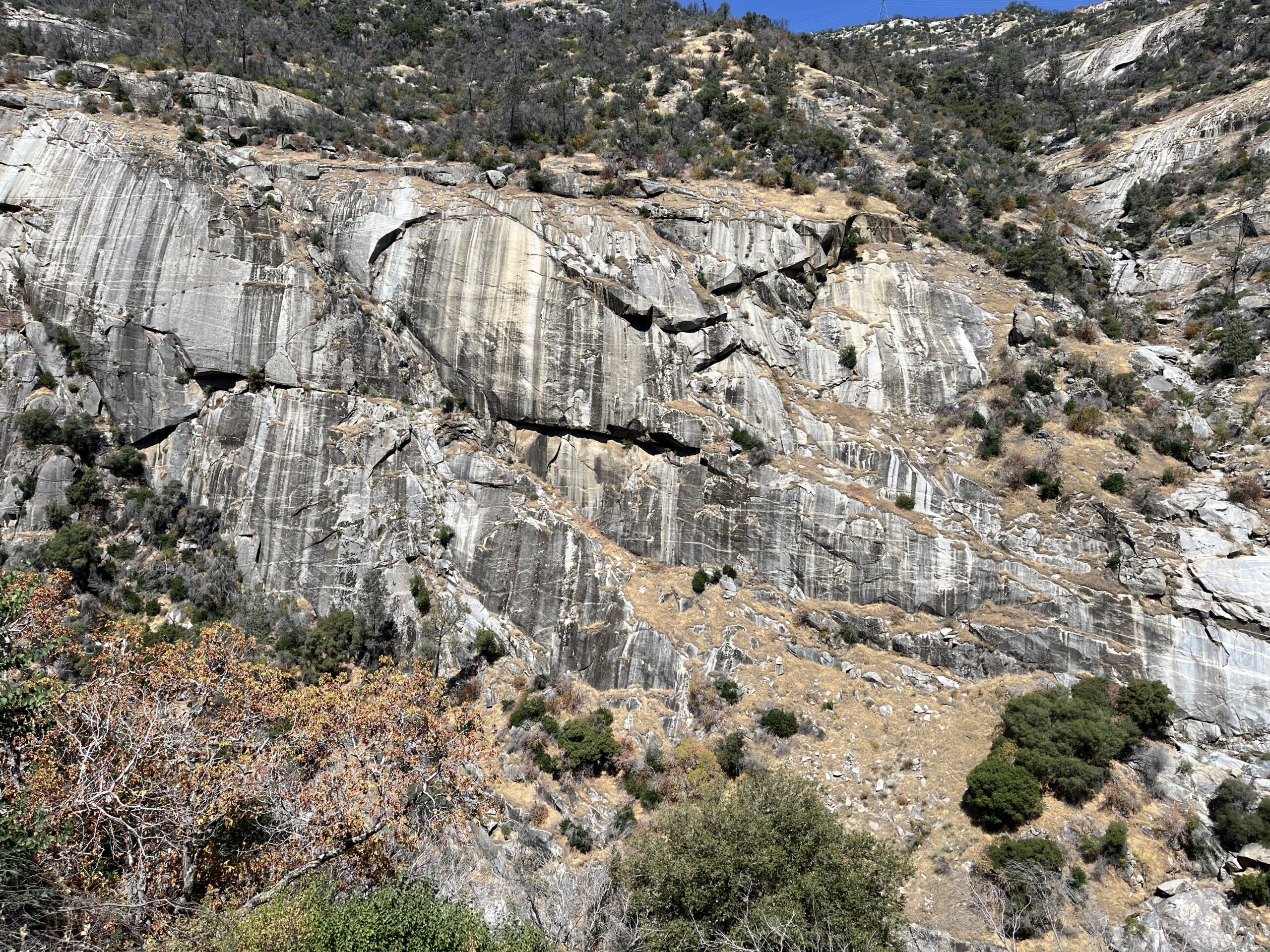
Tthe first 5 miles of KPS I find tedious—Unvaried moderate climbing on a big, wide, relatively straight road without distinguishing feature or variety. About 2 miles from the summit, the road completely changes character—from big to small, from straight to meandering, from an unvaried pitch to up and down, from smooth road surface to sketchy. The landscape improves, because you get above the green wall and start seeing some nice granite. Now you’re IN the Sierra instead of riding past it. I like those last 2 miles a lot. Near the end of the ride there are some nice vistas looking westward over the terrain you’ve just traversed, all unburned forest.

The upper miles

The pass itself is easy to miss. There is a false summit and some signs for turn-offs to Badger Flat just before it, but there is no signage at the summit itself—only two outhouses, a dirt parking area, and a slight downhill to the east. Of course Kaiser Pass Rd. continues on, but the road surface becomes even sketchier (see Adding Miles below).

Once back to the wide, smooth road, the return ride is that sort of thing you may love and I don’t: a 35-45 mph rocket-sled descent without much to do except sit there, in a straight line or on the occasional curve so gentle it might as well be straight. The road surface consists mostly of those little vertical grooves cut into the pavement to aid car traction in the snow, and it’s just disruptive enough to be a slight flea in the ear.

From near the top looking westward

Shortening the ride: Depending on your taste, you might prefer the first 5 miles or the second 2.

Adding miles: As I mentioned, the miles along the north shore of Huntington Lake (Huntington Lake Rd.) are a pleasant, pretty way to add 12 miles (out and back), with some classic, unpretentious Sierra mountain lake resorts along the route. Fire damage is nil until the very west end.

You can continue riding east past the Pass. The road runs for c. 17 more miles, mostly moderate descending, and becomes rougher and smaller, until it’s little more than a track. It takes you to Mono Hot Springs, a locale of considerable interest, and then on to Edison Lake, where it dead-ends just past the Vermilion Valley Resort, which offers you the possibility of overnighting before the ride out. I hear good things about it. Streetview will let you preview almost the entire route.

You can continue riding west from our starting point, but both alternatives have their drawbacks, Hwy 168 has some nice contour but can be very trafficky (especially on weekends), and Big Creek Rd. (discussed at length in the Million Dollar Road ride) is a dauntingly steep descent.

Auberry Road

Distance: 25.3 mi. out and back
Elevation gain: 2988 ft

This is one of the many good foothill rides in the area between Fresno/Clovis and Shaver Lake. This short out-and-back has two features that make it stand out from the others:

1. A killer descent. It’s 9 miles of 30-45-mph rocket sled ride on near-perfect road surface through short straights and wide, lazy turns. Pretty much bliss.

2. The vista. For much of the climb, you can see forever to the west and north. A lot of it was hit by the great Creek Fire burn of 2020, and it’s pretty scrubby landscape anyway, but it’s big.

Of course that descent means the ride out is 9 miles of uninterrupted moderate climbing through the local roadside scenery, which, thanks to the Creek Fire, is nothing special—scrub, with the occasional low-rent ranch—and were it not for that descent and the view, it would be a fairly generic ride.

The Clovis valley sees 100-degree temps in the summer. This ride is just out of the valley, so expect summer temps well into the 90’s. Thanks to the fire, there is little shade. Ride in the spring or the morning.

Begin in the town of Auberry, which miraculously contains two automotive garages and a fine mom-and-pop grocery store, and almost nothing else. Ride to the end of Auberry Rd., then ride back.

Kinda generic going up, swell coming down

If you’re looking for food after the ride, I recommend Velasco’s in nearby Prather.

Shortening the ride: Turn around anywhere on the climb. The further you ride, the longer the descent.

Adding miles: You can loop this ride by riding from the town of Auberry on Lodge Rd. to Toll House Rd. to the east end of Auberry Rd. back to Auberry. There’s an even bigger loop consisting of Auberry Rd. heading westward from Auberry to Millerton Rd. to Toll House Rd. to the east end of Auberry Rd. and back to Auberry. Just remember to ride any loop counter-clockwise, so you get the Auberry Rd. downhill.

From the town of Auberry, Power House Rd. is also worth riding.

For a more extensive discussion of riding the region’s foothill roads, see the Adding Miles section of the Million Dollar Road ride. For details on the unpleasantness of Jose Basin Rd., see the Million Dollar Road ride write-up itself.

Million Dollar Road

Distance: 14.4 mi. out and back
Elevation gain: 1324 ft

This, along with the Kaiser Pass ride and the Auberry Rd. ride, is Bestrides’ introduction to the rich riding region east of Fresno. I’ve just dipped a toe into the area’s resources. In the Adding Miles section of this entry I survey the area’s possibilities beyond what I’ve ridden. If you’re going to the area to ride, be sure to read that discussion.

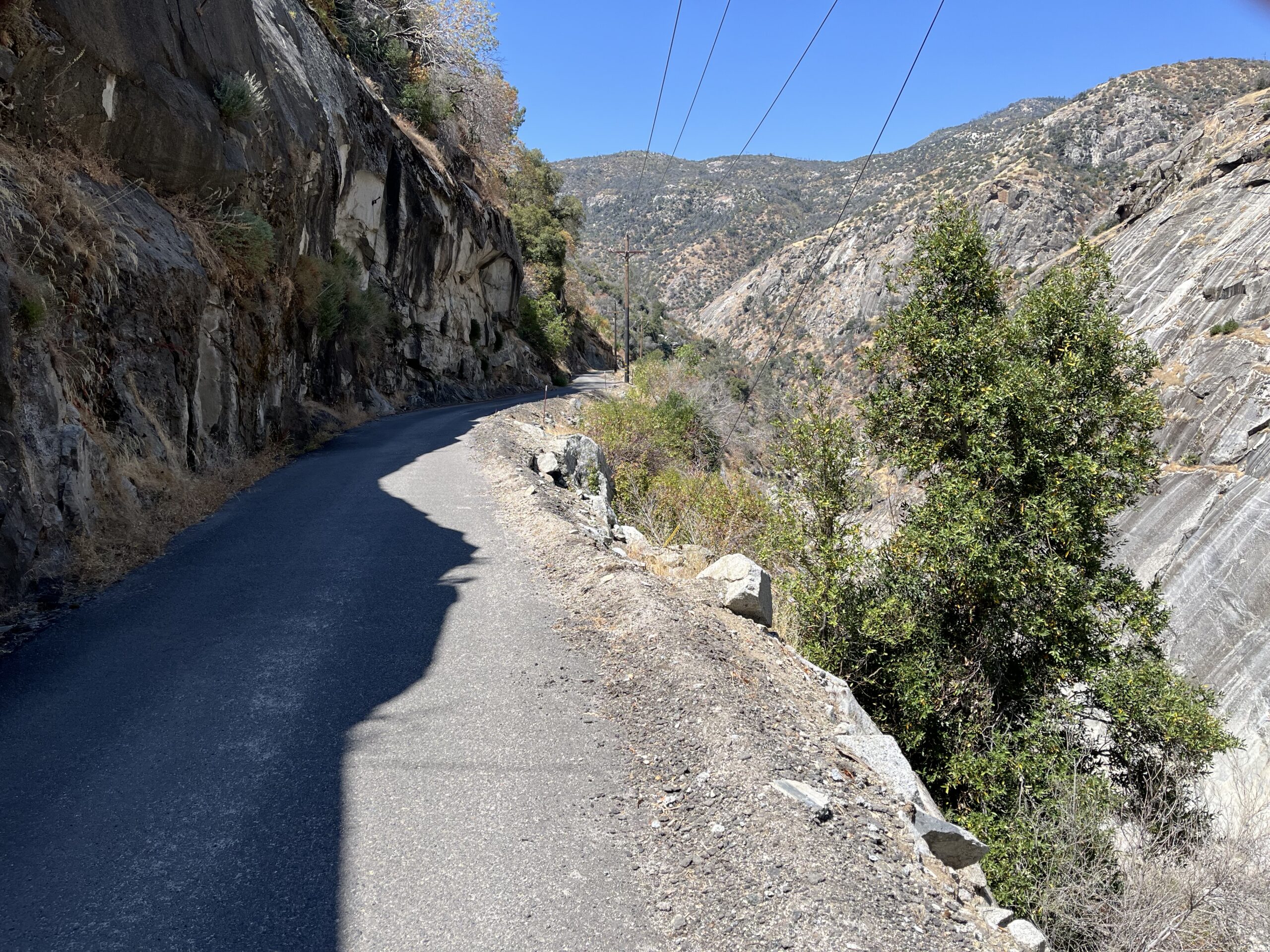
Of our three area roads, Million Dollar Road is the best, a dramatic and memorable ride, and easy to boot. It’s 7.5 miles long and I expect you to do it as an out-and-back, though there’s a sweet 11-mile add-on at the turn-around and a looping option, both of which I’ll discuss in Adding Miles. It’s a relatively flat road (I don’t know where RWGPS is getting its figures, but I did no work) along a steep sidehill through a dramatic rocky San Joaquin River canyon. The rock cuts on your shoulder and the cliff walls across the river are grand. If you’re a rock person like I am, this is your ride.

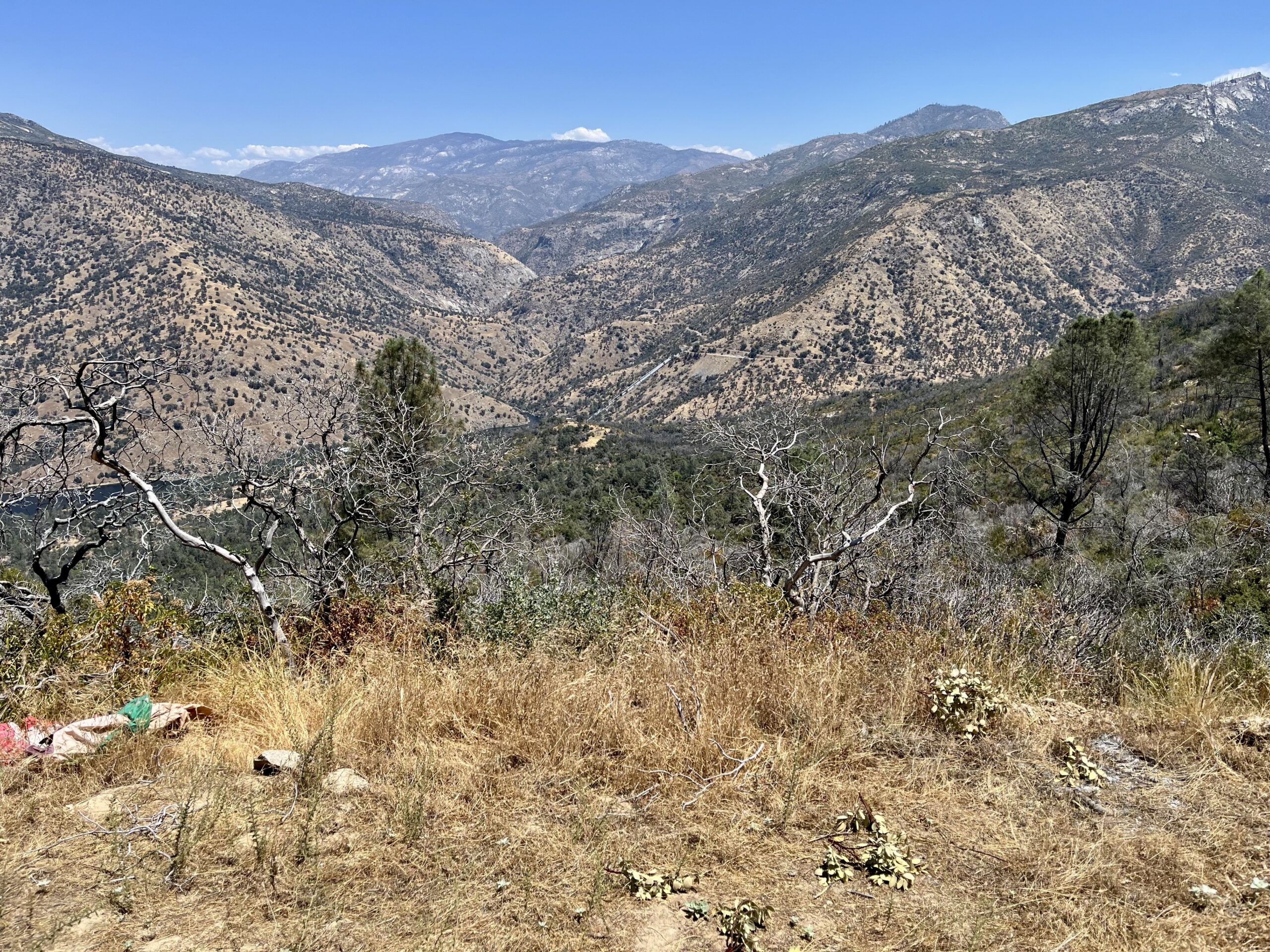
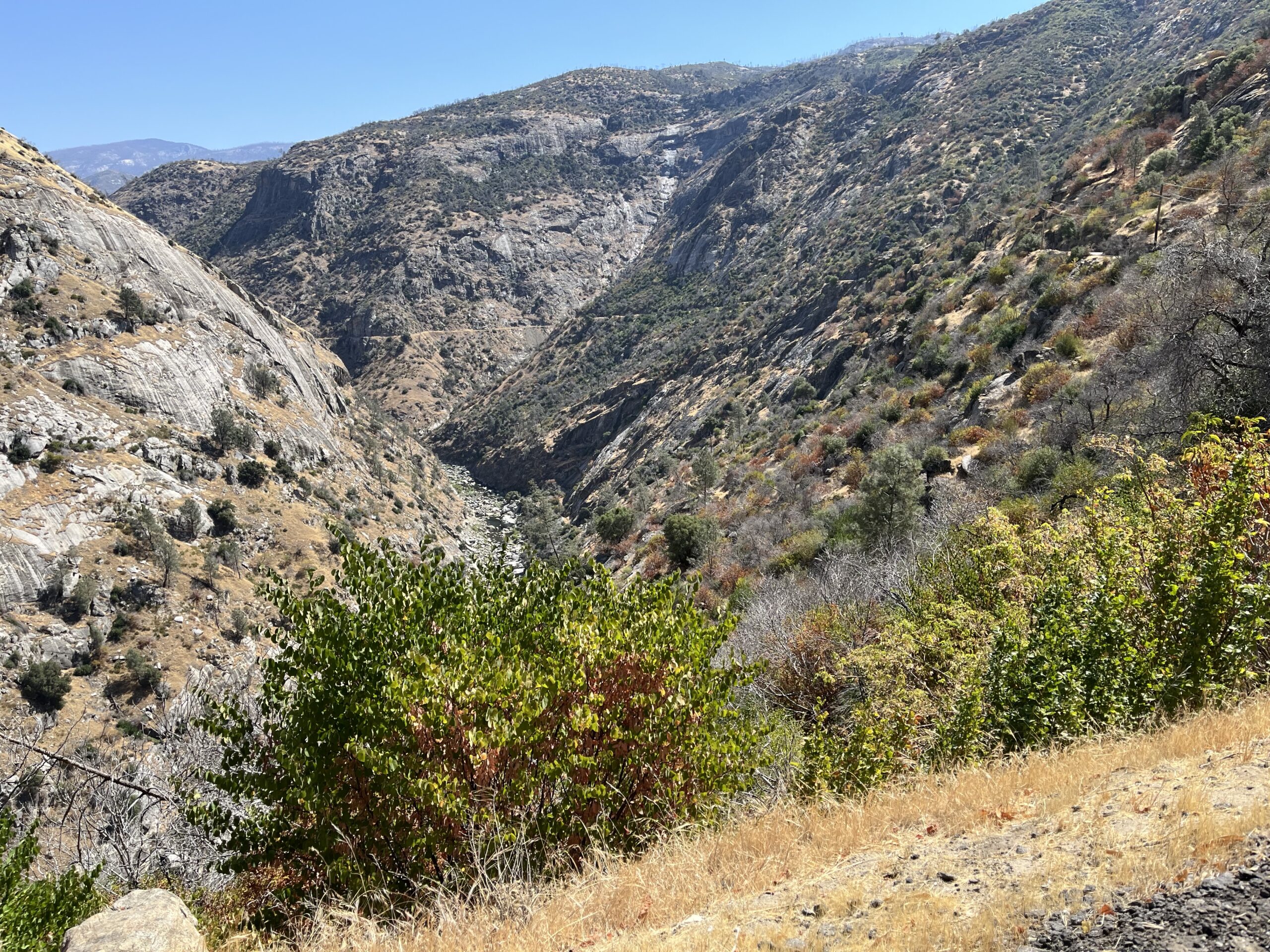
The ride is a tranquil piece of cake (unless you’re troubled by exposure), but it’s hard to get to if you come to it from the south. From the town of Auberry you have 10.6 miles of Jose Basin Rd., a one-lane, battered, twisty 10-mph nerve-racker full of deadly blind corners through unrewarding scrub. I found the drive in much more taxing than the bike ride. It may be easier to come from the west, via Italian Bar Rd. Jose Basin does offer one benefit: miles before you get to MDR you see the San Joaquin River Canyon in front of and far below you, and you can see MDR itself carving its way along the R side of the canyon (see photo below). I know of no other ride you can see the length of from a distance in this way—very dramatic.

MDR is an access road for service vehicles getting to the hydroelectric dam at the north end of the road and the powerhouse, both of which you’ll see on the ride. You can expect to see perhaps one pick-up. The road is a fat one-lane with good pavement throughout, despite RWGPS’s insistence that much of it is gravel.

From Jose Basin Road: Million Dollar Road crosses the canyon wall in the distance

Like most of the geography northwest of Shaver Lake, MDR burned in the devastating Creek Fire of 2020. But the canyon is almost entirely rock, so the effect on the scenery was next to nil. You will see a lot of fire damage on the drive in.

As I said, getting to the ride is harder than doing it. Out of Auberry, go up Auberry Rd. briefly to Jose Basin Rd. and take JBR. In c. 6 miles the road forks (without signage) and the two forks are apparently of equal importance. The L fork seems to head down into the canyon while the R fork stays level. Take the L fork, which is now Italian Bar Rd. Incredibly, my GPS was working at the fork and the roads were labeled. Drive to the river. Million Dollar Road obviously takes off to the R at the prominent spot where the river turns from south to west and IBR follows it. There is a small dirt parking area just W of the intersection. There is no road signage.

Looking at Million Dollar Road

At the start of MDR you must get through a massive gate, with the usual signs warning you of the risks and liabilities you’re undertaking by proceeding. It’s a bitch to get around, over, or under, so if you’re alone (as I was) I recommend waiting for a hiker to come along to help you with the task. This shouldn’t take long—the road seems to be under the radar for cyclists but is well-known to hikers, who come for the falls. On my ride I saw about a dozen walkers.

There are no forks or options on MDR itself. Ride to the dam and a dead-end intersection with an unexpected street sign telling you you’re at the intersection of Big Creek Powerhouse and Big Creek Powerhouse (sic), the Big Creek powerhouse being what you get to if you continue on the new road to the R.—maps call this new road Canyon Rd. (more on this later).

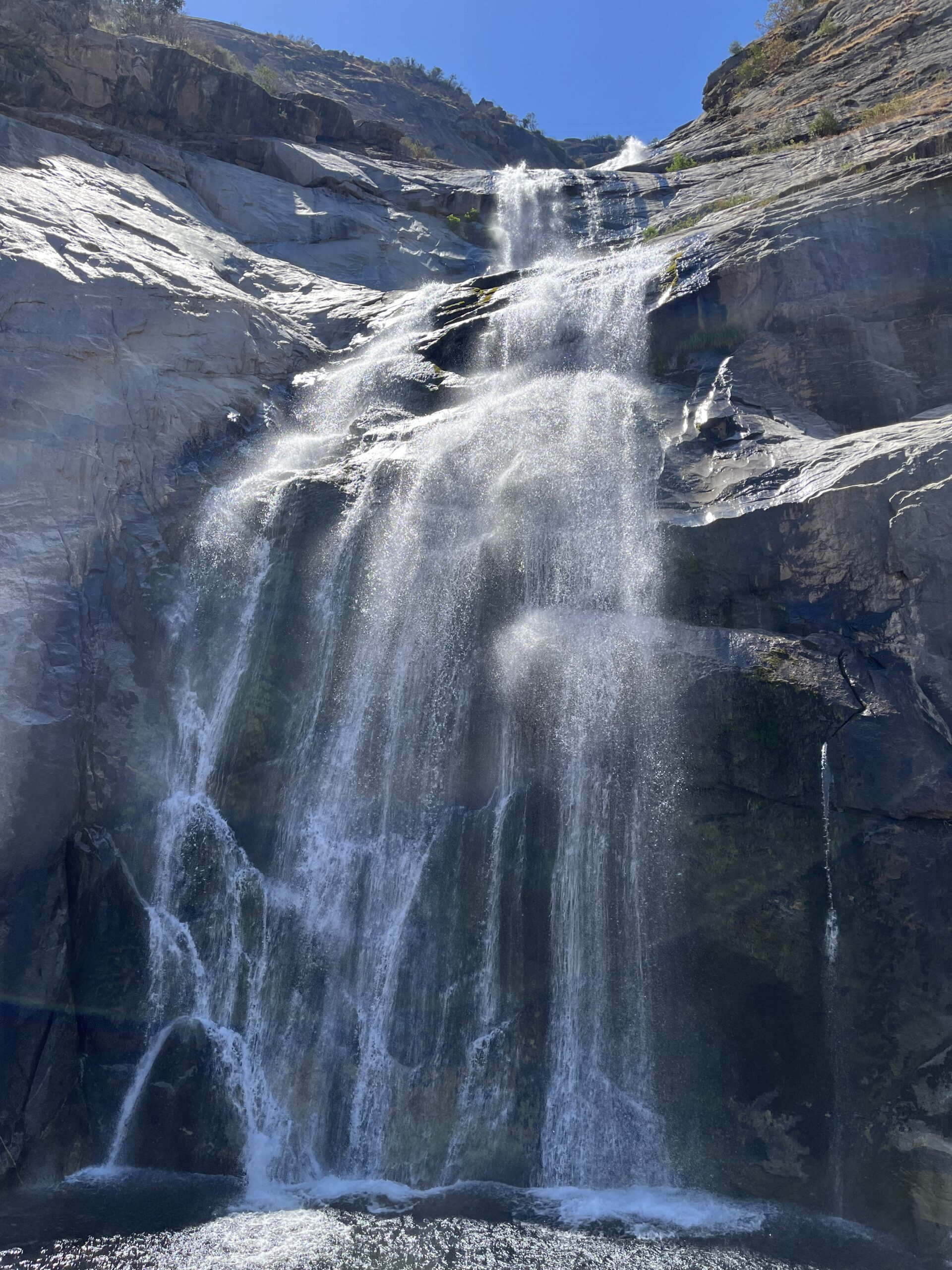
You can’t miss the falls—they’re big and beautiful and the road bisects them on a bridge. I did the ride in late July and there was plenty of water—a hiker told me in the spring when the waters are high they cover the road. So don’t do the ride then.

If you’re a fan of electric grids, there’s a large relay station on the banks of the river right when you start the ride—it’s easy to miss on the way out but clearly visible at the end of the return ride.

The canyon wall

Shortening the ride: There’s no particular reason to, but you can turn around at the waterfall. The road is slightly steeper in the second half.

Adding Miles: Everything discussed in this section is riding I haven’t done.

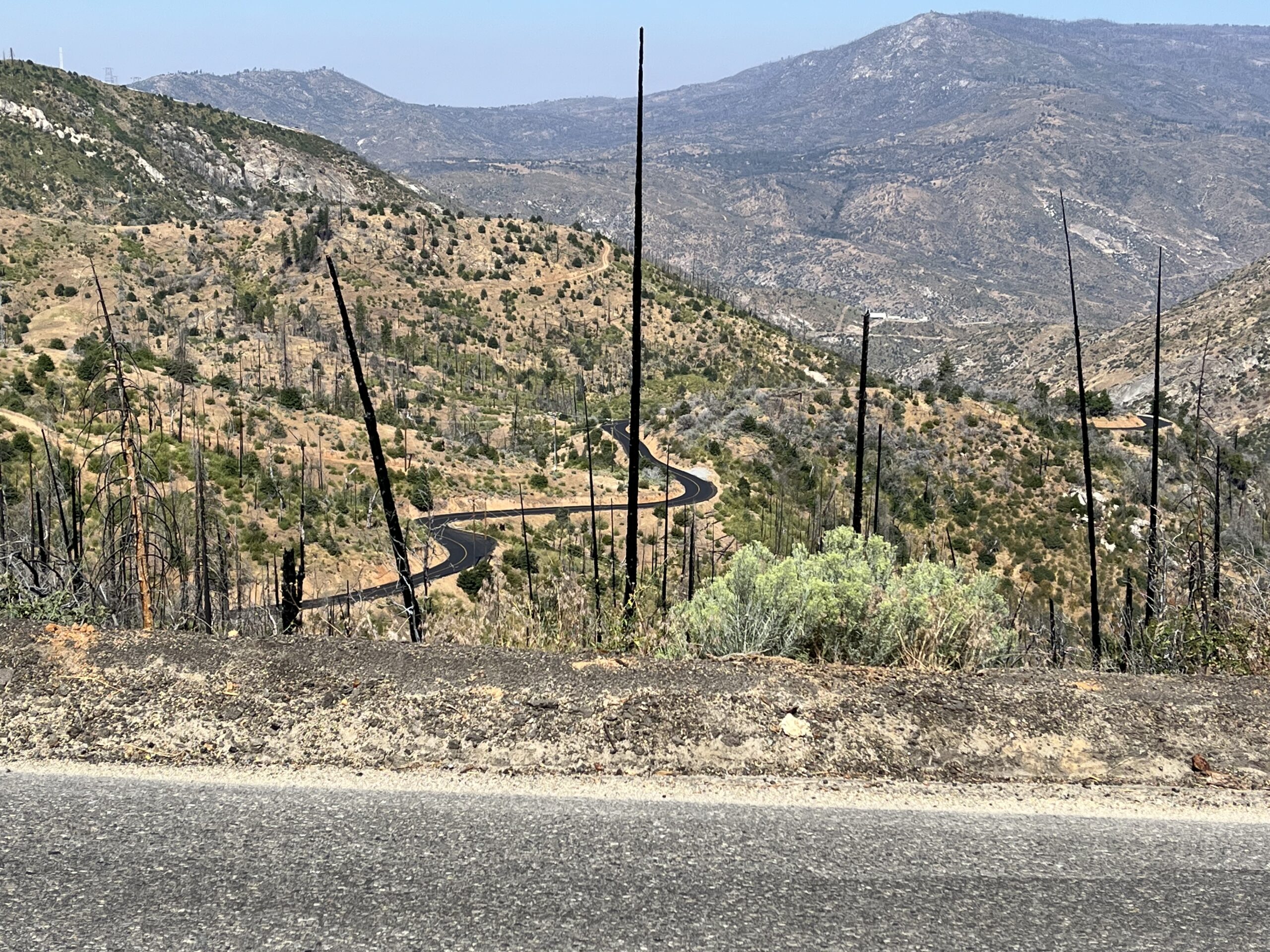
At the turn-around point of our ride you’re at the intersection with Canyon Rd., which runs east to Big Creek (hence the street sign reading “Big Creek Powerhouse”). It’s a 5.8-mile (one way) ride dead-ending at Big Creek Rd., the back road from Shaver Lake to Huntington Lake, a ride I’ll be recommending in a minute. Canyon is all seriously up heading east (2033 ft gain in 5.8 mi.) and it runs directly through the Creek Fire burn, so the landscape is devastated, but the road was recently repaved so the surface is impeccable, the road contour is delicious (very curvy), and the scenery is really rather awesome in an apocalyptic sort of way (see photo below).

You can turn L (the other way) on Canyon Rd. and continue up the river. I’m not sure what it’s like, thought it’s paved at least for a while.

You can make a loop that includes Million Dollar Rd., though it involves some rough or trafficky riding. You can start the loop anywhere, but I suggest you start in Auberry to get Jose Basin Rd. out of the way early. Ride from Auberry to Million Dollar Rd., up MDR, east on Canyon, then at the intersection with Big Creek Rd. take BCR (you’ll have to get through another intimidating gate like the one for MDR, closing off Canyon Rd. to the public) west to Shaver Lake. This leg is a demanding, splendid, constantly serpentining climb on a great road surface—one of the best stretches of road in the area, if you don’t mind the burn. Ride Hwy 168 along Shaver Lake and continue on it down toward the valley and back to Auberry. Hwy 168 is sometimes blessed with a great road contour and sometimes straight as a stick, but it’s always trafficky (trebly so on weekends) and I’d never choose to ride it unless I was keen to complete this loop. I’d map it for you but RWGDP won’t let me map MDR (because it’s gated and officially “private” I suppose). If you do this loop, you are almost entirely beyond the reach of water resupply, so plan accordingly.

Canyon Road seen from Big Creek Road

If you want to explore the other riding in the area:

The best road in the area not in Bestrides is Big Creek Rd., part of the Million Dollar Rd. loop described above. Sometimes confusing called Huntington Lake Rd. on maps, it’s the backroad alternative to Hwy 168. About 10 miles long, it begins (west to east) with about 6 miles of delicious serpentine descending on excellent road surface, then, at the unexpectedly large community of Big Creek the road goes to rough-hewn one- lane and turns up—extremely, unforgivingly up, as in lots of 12-16%—for the remaining 4 miles to Huntington Lake. One of the hardest climbs I’ve ever seen. The country to the north is Creek Fire devastation, but you can see forever and the view is really quite magnificent (though admittedly not pretty). Ride it all (you could continue on along the lake shoreline, 6 miles of perfectly pleasant rollers, then ride our Kaiser Pass ride, or loop back on the trafficky Hwy 168), or skip the killer climb and just descend to Big Creek and turn around.

There are three long, medium-sized roads with good road contour in the area: Beasore, Minarets, and Dinkey Creek. Beasore Rd. has the bonus of Jones Store, a classic country store of some renown. It can be looped by taking the road that goes R just beyond the store and goes over to Minarets, Grizzly Meadows Rd., which I think is paved. It has the huge advantage over Minarets that it escaped the Creek Fire.

Minarets Rd. used to be a plumb ride, but it was devastated in the fire, and reports are that riding it is now a grim experience.

Dinkey Creek has a nice contour and is outside the Creek Fire burn area, and it has two bonuses: McKinley Grove, a small, blissfully uncrowded grove of giant sequoias (I went to see the giant sequoias in Sequoia National Park this summer and couldn’t get a parking space), and Courtright Way (not Road), a small, quirky little road that goes from the east end of Dinkey north to Courtright Reservoir. You can preview it on Streetview.

At the east end of Trimmer Springs Rd. is a road worthy of special mention: Black Rock Rd. (Vomac Rd. for its first few miles). Small and twisty, it passes through Balch Camp and proceeds to Black Rock Reservoir (12 mi.) on pavement, then continues on reportedly technical dirt northward all the way to the eastern end of Dinkey Rd. Word is, the canyon scenery is at first grand, then gets even better as the road passes through Granite Gorge. Ride as far as you are able. The Balch Camp area in 7/25 suffered a forest fire, and I don’t know how that impacted the riding conditions.

Most of the roads in this Added Miles section are snowed in in winter and sport a delicious 70-75% high temp in mid-summer. If you want to ride in the spring, the roads in the foothills (between the Clovis/Fresno valley and the mountains) are said to be lovely riding when everything is still green. Try Watts Valley Rd., Maxon Rd., Burrough Valley Rd., Toll House Rd., Lodge Rd., Millerton Rd., Pittman Hill Rd., Auberry Rd., Powerhouse Rd.—which is pretty much all of them.

South Upper Truckee Road

Distance: 11.5-mile loop
Elevation gain: 1080 ft

This is the only ride in the immediate Tahoe area in Bestrides.  That’s because I don’t like the riding around Tahoe.  I know it’s legendary, especially the ride around the lake.  The century that circumnavigates the lake is one of the most popular centuries in the country.  I’ve ridden in the Tahoe area a lot, including around the lake several times, and in my opinion it all sucks.  The roads, at least in summer, are insanely crowded.  The ride around the lake is 1/3 faux Vegas, 1/3 Tahoe City gridlock, 1/6 a slow tedious climb up Hwy 28 to 50 on a shoulder amidst whizzing cars, and 1/6 actually not bad stuff around Emerald Bay, if you don’t mind narrow, rough roads with no shoulder crowded with tourists gawking at the scenery.  But aren’t the views of the lake majestic?  Yes, for the stretch around Emerald Bay.  The rest of the loop, the lake can’t be seen.

The roads radiating out from the lake— 89 and 267 to the north, , 431 and 50 to the east, 89 to the south—are all straight, monotonous shoulder rides with lots of traffic (admittedly 89 to Truckee is easy and pretty—the rest are tough climbs).   Hwy 50 towards Sacramento would be a lovely ride if it weren’t heavily trafficked—I’ve never seen a bike on it or heard of anyone riding it.

OK, but what about the bike paths?  Lake Tahoe is bike path central.  There’s a path that runs along the road on the west side of the lake from Tahoe City to Sugar Pine Point, a path that runs along the Truckee River almost to Squaw Valley, a path that runs along the south shore from near the Y (the Hwy 89/Hwy 50 intersection) past the Tallac Historic Site, and a path that runs south from the lake to Meyers along Hwy 50.  They’re all fun at 8 mph on a cruiser or mountain bike, but they’re too small-scale for a road bike.  The prettiest by far is the Truckee River trail, and in season it’s packed with pedestrians.

Then there’s the Fallen Leaf Lake Road, a 10-mile out-and-back to a famously lovely little lake with a nice waterfall, Glen Alpine Falls, on the back side.  It’s in all the guides to Tahoe-area riding, and it’s the worst ride I’ve ever done on a bike—one lane of atrocious pavement that’s busy, even in the off-season, with cars, half of them in the act of backing up and pulling off the road to make room for the other half going the other way.  I did this ride in November, when everything around the lake was closed, and the car traffic was still awful—on some stretches I had to pull off the road every minute or two to let a car pass me.

But if you’re a Californian who likes to travel you’re going to spend time around Tahoe, and even hell has one good road ride, so luckily there’s South Upper Truckee Road.  I’d be tempted to add the ride to Bestrides on the name alone (I wish it were Old South Upper Truckee Road, but one can’t have everything—as we shall see, it’s actually Lower South Upper Truckee Rd.).  But it’s also a very sweet ride.  It’s only 11.5 miles long, but in that space you get a stiff 3.5-mile climb, gorgeous scenery, serious solitude, and a fast, straight descent.  The road surface on SUTR can be rough, so our route doesn’t descent it, but instead comes down Luther Pass Rd., which is a wide-open, straight 35-45-mph shot.  The scenery is typical Tahoe aspen, granite, and pine—gorgeous—but the road is essentially one lane and you are IN the landscape in a way you never can be on larger roads.  It isn’t a long enough ride to fill a day, so do it and drive south to the better rides around Markleeville and Hope Valley.

November proved a little late for the annual aspen color display

Park at the intersection of Hwy 50 and South Upper Truckee Road, just west of Hwy 89 and the agricultural inspection station.  There’s plenty of roadside dirt on SUTR.  For 3.2 miles you’re on flat ground among houses as you follow the Upper Truckee River, the upper reaches of the river that runs out of Tahoe and down to the town of Truckee.  Note how the first houses were built closest to Hwy 50, then later ones added further out, so as you ride they get newer and bigger, and still bigger, until the last house is spanking new and comically huge.  You go through some nice aspen groves which must be stunning during the fall color (I was too late).  You pass the clearly marked trailhead for the Hawley Grade National Recreation Trail, which is reputed to be nice for hiking.

Boulder heaven

Soon after the houses end, the road turns up, and is constantly 8-12% for the next 3.5 miles.  These miles are why you’ve come.  Since Hwy 89 goes to the same place, there is no reason why a car should be on this road (unless they’re shuttling mountain bikes—see below) and you should have it to yourself.  It twists and turns deliciously, the road surface has some nastiness, and it gets very narrow—It’s signed “one-lane” at the top.  This is about as close to a mountain-bike trail ride as pavement can get.  I love the scenery—scattered pines and boulders.  This is probably the best boulder ride west of Boulder.  At the bottom of the climb you pass the downhill end of a busy mountain bike trail, which may involve you in some traffic.

After 4.6 miles you meet up again with Hwy 89, and you could turn L and ride the rocket ship back to your car, but our route crosses 89 and continues up a completely unsigned road with an intimidating gate (open except in winter) that is in fact more of SUTR—it is quite literally Upper South Upper Truckee Road.  Continuing on has its risks—this 1.2-mile leg goes by a very large campground, then passes Big Meadows, perhaps the biggest of the trailheads on the Tahoe Rim Trail.  So I would imagine it’s hectic in summer.  I did it in November, and it was deserted.  It’s also utterly delightful, with all the virtues of lower Upper, but curvier and with much better pavement.  It also has the novelty of being utterly unsigned at both ends—given the activity along this road, that’s inexplicable.

When Upper Upper T’s into Hwy 89 (again) at 5.8 miles, turn downhill, to the R (it’s easy to go the wrong way), and strap in for the 3-mile dead straight 7% descent, then 3 miles of flats that take you to 89.

Shortening the route: Not a lot of options here.  Start where the houses end.  Turn onto Hwy 89 when the route first intersects it.

Adding Miles: See the beginning of this post.

At the top of this ride you’re 2/3 of the way to Luther Pass, after which it’s a straight, fast descent to Hope Valley and all the Bestrides riches in the area.

A ride slightly out of the Tahoe area, not quite Bestrides-worthy but totally worth doing once, is Donner Pass Road, which parallels Hwy 80 from Cisco Grove to Truckee.  It’s 23 miles one way, so it makes a nice out-and-back with one significant hill.  From Cisco Grove it’s 13 miles of steady, mild climbing to the Donner Summit Bridge, where there’s a vista point with an unforgettable view of Donner Lake below you, then the one thrilling moment in the ride, an 1100-ft drop through two big esses to the lake.  Donner Pass Road follows the north shore of the lake, and it’s fine, but I prefer taking South Shore Dr. on the other side, which is quieter.  Both routes are lined with vacation homes.  South Shore goes directly through Donner Memorial State Park, then rejoins Donner Pass Rd., which goes through unappealing modern Truckee and ends in the old, charming downtown.

Old Meyers Grade, aka Lincoln Highway Trail, forks off South Upper Truckee Rd. immediately after the beginning of our ride and climbs rather steeply for about 1.5 miles to Hwy 50 (see Don’s comment below).  Where it dead-ends, you can go R on Hwy 50 for about 50 ft and take a very small, unmarked one-lane road on your L, Echo Lake Road (though there is no signage), which continues on for two more miles to Echo Lake.  It’s a wild and wooly ride on poor pavement.  The last time I was there, OMG was gated off at both ends but the gate was jumpable.

There is a North Upper Truckee Rd., almost directly across Hwy 50 from the beginning of South Upper Truckee, but it isn’t worth riding—it looks appealing from the highway, but it’s soon mired in mountain subdivisions.

Afterthoughts: Once back at the intersection of 89 and 50, you can do a very short ride up 50 toward the lake and eat at Pretty Odd Wieners, a highly rated hot dog stand (actually a trailer) in a gas station parking lot on the R.  Or a stone’s throw up 50 from the intersection on the L is Burger Lounge, whose burgers are the standard by which all others are measured.

Caliente Loop

Distance: 44-mile loop
Elevation gain: 4320 ft

(A Best of the Best ride)

If you’re like me, you think Bakersfield is flat, which is what you see driving through on Hwy 5.  But a Friend of Bestrides wrote in to say I had to overcome my prejudices and try the area.  It turns out that Bakersfield, while it is smack in the middle of the San Joaquin Valley, is at the Valley’s southernmost tip, so it’s surrounded closely on 3 sides by mountains like the Tehachapis, and there are good roads in those mountains.   The Caliente Loop is the jewel in the crown.

But there’s a problem: I can’t decide which direction is better.  I rode the loop counter-clockwise.  Most locals ride it clockwise.  I’ll describe my ride; then we’ll weigh pros and cons of the two directions.

The loop (called Lion’s Trail by the locals) is essentially three different rides: a gentle meander through a small, rocky creek canyon; a flat and rolling leg across a wide valley dotted with horse farms and sagebrush, and a descent of epic proportions with vistas of the canyons on both sides of the road.

Caliente Creek Road in October

This is a ride you want to time correctly, and the window is small: ideally you’d ride in the spring, when the creek you’ll follow for the first 20 miles is babbling and the grassy fields of the second leg are green.   But spring means spring run-off, and any significant run-off closes the road, because Caliente Creek Rd. has several places where high run-off water flows right over the roadway.  I’d expect to find a “road closed” sign and ford some streams any time before the dry season.

Summer poses its own problems.  Bakersfield in the summer is hot and often windy, and the middle leg through Walker Basin is totally exposed.  On a typical summer day I’d start early enough to get through Walker Basin by 10 AM.

One more word of warning: you will notice the road surface is sprinkled with the remains of dried cow patties. Cows put them there.  This is open range, and you may meet cows standing in the middle of the road at almost any point.

Caliente Creek Rd, with typical creek crossing

Park in the “town” of Caliente, which is a tiny post office and around 20 unprepossessing houses.  On the way there, assuming you’re driving from Bakersfield, you’ll see the turn-off to a road with one of my favorite road names: Weedpatch Highway.

The first 16 miles or so from Caliente are easy, but conserve energy, because you’re going to climb almost without interruption for 22 miles, and the last 6 miles are taxing.

Ride the 3 miles to the Y of Caliente Creek Rd. and Caliente Bodfish Rd.  (clearly signed, as Cal Creek Rd and Cal Bodfish Rd).  Turn R onto Caliente Creek Rd.  It’s an easy grade up through a scenic and charming little canyon—my favorite part of the ride.  It’s a classic desert canyon, with bold rock formations, sycamores, and impressive cottonwoods.  

The canyon is almost people-free, but at “Lorraine,” which is only an intersection with Indian Creek Rd. (signed), the canyon widens, the area becomes more domesticated, and houses become common.  The land gets flatter and more open and the population and affluence level keep increasing until Twin Oaks, when you’re in the land of high-end “equestrian” training facilities.  Twin Oaks is a real community, with a general store (now closed), a second-hand store, a school, a cafe (Tog’s, which I couldn’t find), an absurdly large contemporary church, and even a town sign.  Everything but residential streets (everybody has a ranch).

Walker Basin Road

Around Twin Oaks the pitch increases substantially, and from there to the summit at 22+ miles in you will work.   The summit follows a series of false summits, but it’s unmissable: Piute Mtn. Road takes off to the R (signed), and signs tell you that Cal(iente) Creek Rd is ending and Walker Basin Rd is beginning.

Walker Basin is a large open valley surrounded by hills—classic high desert, mostly unpeopled but with a few hardscrabble ranches.  After the summit you descend to the valley floor, which is relatively flat and straight and the scenery OK or great, depending on how you feel about sagebrush desert.  

The descent on Cal-Bodfish Road—MUCH steeper than it looks

At mile 29 you have your first significant intersection since you turned onto Caliente Creek Rd., a 90-degree L turn from Walker Basin Rd. onto Walker Basin Rd.—clearly signed, just like that.  Take it.  In 3 miles of easy riding you T into Caliente Bodfish Rd.  Go L.  You’ll do a 2-mile, 700-ft climb (tough this far into the ride if you’re as tired as I was), roll for a couple of miles across the summit, and drop into the descent, which takes you all the way back to the Caliente Creek/Caliente Bodfish intersection, which you rode through before.

View from the descent

This descent is simply astonishing, a seemingly endless series of steep-to-very steep esses, sometimes on a ridge spine with breath-taking views of the canyons on either side of the road, sometimes deep in gorgeous tree-and-rock-wall forest.  It would be one of the top descents in Bestrides were it not for two problems: 1) early and late it’s magnificent, but in the middle miles it’s so steep all you can do is grab your brakes and pray they don’t overheat—not much fun if you still have rim brakes; and 2) the road surface is often badly broken up, so you’re constantly having to abandon your line through a turn and improvise a new one, which means you have to go slow—again, not much fun.  Joe in the comment below says the lower half has been repaved, which helps. As it is, it’s still pretty mind-boggling.

From the intersection with Caliente Creek Rd it’s 3 miles back to the Greater Caliente Area and your car.

Which way to go?: See the vigorous debate about this in the comment section, with me on one side and everyone else on the other.  Make your decision by the kind of climbing you like to do.  Clockwise puts all the climbing in two pitches.  The first, 3 miles in, is a monster—7 miles with lots of 10% stuff.  The second is a more moderate climb out of Walker Basin.  Everything else is down.  Counterclockwise spreads the climbing over 24+ miles of route, so the pitch averages less than half that of the other direction, and the climbing is never brutal.  Wind direction may also factor in your decision, since Walker Basin is open and largely flat and the prevailing westerly is in your face on the counterclockwise route.

Shortening the route: Start at the intersection of Caliente Creek Rd. and Caliente Bodfish Rd.  Ride to the Indian Creek Road intersection.  Turn around.

Adding miles: Bestrides commenters offer up several great suggestions for routes below.  Other local routes are at https://kernwheelmen.org/routes/, though the heartless Kern Wheelmen require you to join the club (in other words, pay them) before you can access the site.  Popular rides are Breckinridge Rd. and Hwy 155/Evans Rd from town to Greenhorn Summit, both big climbs.  Hwy 155 is a moderately tame road and I don’t find that I need a ton of it.  A shorter version of the Hwy 155 ride starts in the town of Woody (named for a guy who last name was Woody) and immediately goes uphill for 6 miles of moderate work.  Those 6 miles are a hoot coming down, so it makes for a nice 12-mile, one-hour+ outing (see photo below).  

The area around and north of 155 is full of roads all worth riding: Portuguese Pass, Hot Springs Road, Sherman Pass Road, and everything near to or connecting them.  The drawback is, everything in this area is geologically and botanically similar (rolling grassy hills and small canyons dotted with rock outcroppings and oaks), so one road is much like another, and after a while I want to see something else.  I’d suggest going with the smallest road I can find, but that’s me.

One quirky little road I really like and you’re unlikely to find on your own is the 9 miles of Woody Rd between the town of Woody and Tule Rd.  It’s deserted, with a road surface that’s a bit beaten up but totally rideable, a wonderfully random contour, and some dramatic rock clusters I found nowhere else in the area.  To the west you have a vista overlooking 30 miles of featureless grassy mounds.  Don’t take the road’s name literally—there isn’t a tree anywhere near your route, so don’t ride it on a blistering summer day (see photo below).

Deserving of mention for sheer audacity is Deer Trail Drive (aka Deertrail Drive and The Bear, for obvious reasons), a climb on private property that’s 9 miles long and averages 10.6%!  I haven’t done it and have no intention of doing it.

Highway 155
Cows are an ever-present possibility on the Caliente Loop
Woody Road

Kings Canyon

Distance: 68 miles out and back
Elevation gain: 7980 ft

(A Best of the Best ride)

(This route has been closed for the past couple of years due to rockslide damage, but is now fully open.)

I’m not a great fan of riding in National Parks.  They’re too crowded, they aren’t bike friendly, and they usually have only one or two paved roads, onto which thousands of cars are funneled and forced to fight for room.  Our Lassen Volcanic NP ride is an exception, made attractive only because almost no one goes there and you can have the road largely to yourself.  (The Yosemite tour is there because Yosemite is too imposing to ignore.)

Another exception is Kings Canyon/Sequoia National Park(s).  They’re two parks, but they’re contiguous, so everyone thinks of them as one.  You often aren’t sure which of the two you’re in.  The riding is excellent and extensive.   While Yosemite offers you two roads and Lassen one, KC/S has no less than ten paved roads, and they’re all well worth riding.  Not a lot of people seem to know this.  In my five days of riding in the two parks, the only person I saw on a bicycle of any sort—road bike, mountain bike, BMX, cruiser—was me.

Of course there is always the traffic problem.  I wouldn’t go near any National Park in high season, and even during the shoulder seasons (spring and fall) I adhere strictly to the EMOW rule: ride Early Morning, Only on Weekdays.  I did my KC/S riding in late September, and my EMOW rides saw a car per mile or less.

The ride outlined here is the best of the ten, by a long shot, one of the best rides I know of anywhere and a hands-down Best of the Best ride.     It’s an 8-mile descent into a rock canyon of indescribable grandeur, then an 18-mile meander between towering granite and marble walls and through a beautiful glacial valley along a perfect Sierra stream.  If you ride for the Wow Factor, if you love to be awed, this is the ride for you.  There may be other rides as pretty or as pleasant, but none more mighty and imposing.  Photos can’t do it justice.

I’ve mapped the ride from the obvious starting place, but if you want to get the climbing out of the way first (and I’m with you), drive to Convict Flat Overlook, park, ride back up the hill to the forest line, turn around and descend to your car, then continue on to Road’s End and turn around.

It’s a big ride—69 miles, 8000 ft of gain.  In Shortening the ride I’ll show you ways to cut it down that maintain the grandeur.

By the way, the name of the park and the canyon is Kings Canyon, not King’s Canyon.  It’s a translation of Canon de los Reyes, “Canyon of the Magi.”

Our route starts in Grant Grove Village, one of the two large communities in KC/S.  Ride north on Hwy 180 until it dead-ends at Road’s End 34 miles later, then ride back.

img_9777

An early glimpse of the canyon—click on photo to see your road in the center of the photo

At first the ride does not impress.  You do 3 miles of up, then 5 miles of down through plain Sierra forest.  The truth is, the forest here is dry, rather bedraggled, and often fire-damaged (though not as bad as KC/S’s other highway to the south, Hwy 198), and the road contour is only OK.  At Mile 6.7 you pass the turn-off to Hume Lake, and at mile 8 you emerge from the trees and see the canyon you are going to ride into, at which point your heart soars like a hawk (or trembles like a leaf, depending on your nature).  Kings Canyon is enormous and mighty—deeper than the Grand Canyon in places—and you’re going to spend the rest of the ride exploring its wonders.

img_9365Drop 8 miles and 2400 ft through a Best-of-the-Best descent.  You’re passing turn-out after turn-out with incredible views, but they’re easier to take in when you’re climbing out at 7 mph.  After you pass the foundations of Kings Canyon Lodge, destroyed in 2015’s devastating Rough Fire, the road takes a right turn and levels out and meanders up and down to Boyden Caverns (closed for years but recently reopened and worth a visit).  The few miles from the leveling-out to just past Boyden are the geologically richest and visually most spectacular miles on the ride—linger and take in your surroundings.  I know of no riding to match it.  Mother Nature has done some of her best rock work here.  Soon the road joins up with the Kings River, a boulder-strewn series of cascades and pools, to add to your pleasure.

img_9794Just past Boyden the nature of the ride changes.  The canyon goes from being water-carved (vertical V-shaped) to glacial (wide, open U-shaped), the river becomes tranquil, and you begin a steady, easy 10-mile climb to Cedar Grove.  The elevation profile makes this look harder than it is—you’ll climb about 1500 ft in 11 miles.  Halfway to Cedar Grove you pass Grizzly Falls (clearly signed), an unpaved 40-ft walk from the road.  Worth seeing.

Best rock anywhere

Amazing rock

One mile before Cedar Grove the road crosses the river on a large bridge and a smaller road, Cedar Grove Road (unsigned), takes off to the L (staying on the north side of the river).  It’s a back door into Cedar Grove, and if you take it (in either direction) it will save you one small but rather steep hill.  My mapping forgot to include it.  At Cedar Grove there’s a snack bar (with board games!), water, good bathrooms, lodging, and all the things  you expect from a National Park complex.  If you’re seriously out of season, check what’s open and what’s shut before you ride, so you don’t get surprised.

Kings River

Kings River

You could turn around at Cedar Grove, of course, but the 6 miles of road remaining offer three rewards.  1. Roaring River Falls, a .2-mile paved walk from the road, is an exquisite little falls into an emerald pool—don’t miss it.  2. Zumwalt Meadow is a classic Sierra meadow with an educational hike around its perimeter.  This takes walking shoes, since you can’t see the meadow from the road or from the parking lot.  3. The last 3 or so miles of the road enter a glacial canyon with towering rock walls surrounding you (very reminiscent of Yosemite and El Capitan).  The tallest of them, to the south of you, is Grand Sentinel.

img_9465The ride back to Boyden Caverns is effortless.  Not so the rest of the ride.  You’re going to climb 3600 ft in 13 miles.  None of it is really steep, and the vast bulk of it is 4-6%, but that’s still a lot.  Mind your water.  There is no water source after Cedar Grove, so if you aren’t going to wear a hydration pack you might think about dropping some water midway on your original descent (this is another argument for starting in the middle and riding up the climb first—you pass your car midway through the ride).  Be sure to stop at every turn-out, wide spot in the road, and overlook to take in the vistas.

The glacial canyon

The glacial canyon

Shortening the ride:   First, cut the first 8 miles.  It isn’t rewarding riding and it adds 1000 ft of climbing.  I drive to where I can see the canyon and start there.  Second, if you aren’t up for a big climb, drive to where the road levels out (past Kings Canyon Lodge) and ride to Road’s End and back—36 gorgeous miles that includes the best of the canyon’s geology.  Total elevation gain 3000 ft.  If you want less, drive to the Convict Flat Overlook, drive the obvious descent that follows, park when it ends, and ride to Road’s End.  That will save you 500 ft.  If you want even less and want to ride only the most spectacular geology, start at the same place and ride to Cedar Grove.

Hangin' at Roaring River Falls

Hangin’ at Roaring River Falls

Adding Miles: Surely you’re done for the day after this ride, but there are lovely rides all around you for other days.  My favorite is Big Meadows Road, 11 miles of pavement before it turns to dirt, with one nice descent and one nice climb, an almost deserted dead-end road used only by hunters and horse packers.  Also very nice is Hume Lake Road/Ten-Mile Road, 14 miles of not-too-steep, more domesticated back road that passes a very pretty lake with an interesting history (it used to be a logging mill pond).  It’s also the only ride in the parks you can do as a loop.  The ride to Panoramic Point is a brisk, sometimes quite steep 2 miles that’s a wonderful little luge run (and the panorama at Panoramic Point is marvelous—expect a short paved hike doable in bike shoes or bare feet).   All the other roads—Mineral King, Crystal Cave, Crescent Meadow, Buckeye Flat, Little Boulder Grove—have their appeal and will reward if you can catch them at a low-traffic time.  Just remember than the highways of KC/S are on a spine, so roads that leave them tend to go down, usually precipitously—then they come back up when you turn around.

img_9364

Approaching Boyden Caverns

Hwy 198, the major artery southward through Sequoia NP, is a mixed bag.  It’s all very pretty—the best woods in the parks—but it has no shoulder and obviously can be busy.  From the intersection with 180 to Big Meadows Road it’s pleasantly up and down, nice if you can catch it early before the cars are out.  From Big Meadows to Giant Forest the road is more extremely up and down, but still quite rideable.  At Giant Forest the road begins a wonderful 23-mile descent to Three Rivers.  It’s a long climb back, but if you can arrange a shuttle or hitchhike I’m told it’s dreamy.  In the Giant Forest area you do get to ride right by some splendid Giant Sequoias.

See Jeff’s comment below for an excellent survey of rides in the foothills south of the parks.

Afterthoughts

Most of the riding I’ve discussed isn’t actually in the National Parks.  The borders of KC/S are odd, so many of the rides are on roads in the surrounding Giant Sequoia National Monument or Sequoia National Forest.  Only the first 2 and last 7 miles of the Kings Canyon ride is in Kings Canyon National Park—in fact, none of Kings Canyon (the canyon itself) was in the park until recently, when the park was expanded to include the last 7 miles of Hwy 180.

Blue Lakes Road

Distance: 23.6 miles out and back
Elevation gain: 1730 ft

This ride isn’t thrilling.  But if you’re in the mood for a mellow jaunt through pretty High-Sierra country, you can’t beat it.   It’s a idyllic ride, perfect for a recovery day after you’ve tackled one of the harder rides in the area—Carson Pass, Ebbetts Pass, or Monitor Pass—or for a day when you only have an hour or two in the morning or evening to ride.  It’s all easy climbing (1730 ft. in 24 miles), with a  brilliant blue Sierra lake at the turn-around for snacking or meditation.

Blue Lakes Road isn’t plowed in winter and is therefore impassable above the snow line.

(The RidewithGPS map shows the pavement lasting longer than I think it does.)

Begin at the junction of Blue Lakes Road and Highway 88, which you pass on the Carson Pass Plus ride.  There is no “Blue Lakes Road” sign per se, but there are signs reading “Blue Lakes 12” from either direction on 88.  There is a nice dirt area for parking on the SE corner of the intersection, and if you don’t like leaving your vehicle on roadsides it’s a pleasant, flat ride from Sorensen’s Resort (which seems to have been renamed Desolation Hotel—see the Carson Pass Plus ride for details).

Just your basic pretty Sierra scenery

Just your basic pretty Sierra scenery

Ride to the end of the road.  After the first couple of miles of flat, You’ll climb pleasantly for about 6 miles, then climb moderately for a mile to a summit at mile 9, then descend 2 miles to a junction at Lower Blue Lake.

As you ride, enjoy your surroundings.   This is not the time or place to hammer or train.  You’ll pass meadows, ponds with dark green conifers reflected in their waters, great boulders, and signs of cattle ranching, with a background of lofty mountains flecked with snow (in season).

Near the summit, looking back on the climb

Near the summit, looking back on the climb (road visible in center)

At the junction there’s a wooden sign reading “Blue Lakes Basin,” a board with some interesting history, and a map showing that four lakes lie in front of you.  If you’re on a gravel bike you can ride to any one of them, but the roads are all dirt, so if you’re on a road bike you have one option: ignoring the road into the campground directly ahead of you, take the road on your R, ride along the edge of the campground until that road turns to dirt, then ride the dirt for 1/4 of a mile along the shore of Lower Blue Lake until you see granite boulders jutting out into the water.   You should have the place to yourself.  Bliss out.

Lower Blue Lake

Lower Blue Lake

On the return you’ll do an untaxing 1-mile-or-so climb back up to the summit, then have some thoroughly pleasant moderate descending for the bulk of your ride home.  No hairpins, no daredevil 40-mph straights.  It’s all rejuvenating, not draining, and you end the ride fresher than when you started.

Adding Miles: This ride lies between two Bestrides.org rides, Carson Pass Plus and Ebbetts Pass.  See both those rides’ Adding Miles sections for other possibilities and information on the area.  The miles of road between Sorensen’s and Markleeville are almost all trafficky, straight, monotonous, moderate descending—effortless in this direction but not particularly rewarding.

Sierra Nevada rocks!

Blue Lakes Road boulder

Carson Pass Plus

Distance: 67 miles one way
Elevation gain: 3015 ft

Here’s the rare opportunity to ride 67 miles in one direction, all of it really good.  This ride is a trip through a lovely aspen-strewn Sierra valley, a famous climb up and over the most scenic of California passes, a long stair-stepping descent back to the foothills, a slalom course through vacation home country, and a final mellow leg though a classic old farming valley.  It’s more than anyone is going to ride as an out and back, which is OK because I can only recommend it in one direction, east to west.    See Shortening the route below for tips on how to arrange a manageable day if you don’t have a shuttle.  I did the ride as part of a 4-day loop tour that started in Sacramento and passed by Lake Tahoe.

The first part of this ride, Hope Valley to Carson Pass, is famous as the fifth and last climb of the Death Ride.  Park at Pickett’s Junction, where Hwy 89 meets Hwy 88.  The parking is much more comfortable a mile east at Sorensen’s Resort (which seems to have been renamed Desolation Hotel—a great place to see aspens, hike, eat, or just hang out), and I’ll leave you to decide how you feel about using their parking lot if you aren’t spending money there.  Ride west on 88 through the beautiful Hope Valley (if you can manage to do the ride in the fall when the Aspens are turning colors, so much the better).

Hope Valley

Hope Valley

Soon you leave the valley floor and beginning the stunning ascent to Carson Pass.  The climb itself is pretty much of a slog—unvaried 6-7% pitch and pretty straight—but visually there is nothing like it.  The last 3 miles of the climb are open in front of you, the road is carved out of solid granite, and the view of Red Lake behind and below you gets more and more striking as you ascend.  It all looks easy on paper—about 1500 ft of gain—but the elevation is a famous sapper of legs here, so trying to power up the climb is asking for trouble.  I settle in at a docile 5.5 mph, look around at my surroundings, and spin it out.

The climb to Carson Pass

The climb to Carson Pass

There’s a small Visitor Center at Carson Pass (with bathrooms).  It caters to hikers on the Pacific Crest Trail, which crosses the road there, and it’s a friendly and cheerful spot worth a stop.  They even have loaner hiking poles.  A lovely 2-mile round-trip hike to Frog Lake starts there, if you have an hour and brought hiking shoes.

Caples Lake

Caples Lake

If you’re just out for the afternoon, turning around at the Carson Pass summit will give you a 20-mile outing, and you get to see the scenery twice, but I confess the descent from Carson Pass is for me without reward.  If you like straight, very fast, wind-blown, brake-straining coasting, you’ll love it.

If you continue on, the scenery stays classic High-Sierra wonderfulness for the next 30 miles—mighty granite, deep green forest, endless vistas.  After the fast, sweeping descent from Carson Pass, you meet Woods Lake Road going off to the L, and you can take that road for a short, lovely ride to minute, picture-perfect Woods Lake, an ideal spot for a break, a bit of meditation, or an easy short hike.

Carson Spur

Carson Spur

Back on 88, you pass Caples Lake, then Kirkwood Ski Resort, then a moderate climb up to and around Carson Spur, a granite monolith (stunning vistas off to your right).  Then it’s down to Silver Lake, a lovely area to take a break (more secluded than Caples) or camp.   Past Silver Lake you do a straight, tedious climb (a tough way to start the day if you camped at the lake), descend, and begin watching for Mormon Emigrant Trail on the R.  It’s prominent, but the main road is a fast descent here and you can blow past it.

View from Morgan Emigrant Trail

View from Mormon Emigrant Trail

Mormon Emigrant Trail, despite its name, is a road—a big, wide, fast roller coaster.  It’s like Hwy 88 cubed—smaller, windier, same great vistas, and lots less traffic.  It rolls up and down, mostly down, and it loses a lot of elevation over its length, so it’s tons of fun going east to west, with just enough climb in the rollers to make you feel like you’re earning this.   Going west to east, the elevation change works against you, and that’s the only real obstacle to doing this ride in the other direction.   Just past halfway you’ll pass the turn-off to North South Road, in our list.

Mormon Emigrant Trail debouches at Jenkinson Lake, AKA Sly Park, and the ride changes.  Cross the dam and stay L onto Sly Park Rd., which traverses pretty wooded country but is built up with vacation homes and thus can be heavily trafficked.   It’s a rollicking slalom descent, so if you can catch a break in the traffic it’s an absolute hoot—with traffic, the cars keep making you slow down.   Stay on Sly Park all the way to Diamond Springs.

Mormon Emigrant Trail

Mormon Emigrant Trail

If the traffic is bothering you, there’s an escape route: Sierra Springs Drive (or Road).   It takes off to the R soon after you start down Sly Park Rd. from the lake.   Most maps think it’s a dead-end residential road into a subdivision, and it was, but if you summon your blind faith in me and head down it, it goes through the subdivision through a few spectacular esses (worth the detour by themselves) and turns into Starkes Grade Rd., which is a road so small it might as well be a rec path, and which descends gently along the most gorgeous little creek you’ve ever seen.  You’ll think you’re in a Japanese garden.  It’s a very special place.  Our mapped route goes that way.  Starkes Grade ends on Newton Rd., and you’ll need to go L on Newton for a ¼ mile or so to get back on Sly Park.

Somewhere in here Sly Park Rd. changes its name to Pleasant Valley Rd., and that tells you exactly what you’re in for: a very pleasant, easy ride through a traditional farming valley.  Ride to Diamond Springs, where the riding quality drops off precipitously and our ride stops.

Shortening the route: If you only have one day and you can’t arrange a shuttle, I suggest you start at Carson Pass, look at the vista to the east, then ride west as far as you wish, then return.  It’s 17.5 miles to the Mormon Emigrant Trail turn-off, and those miles will give you 3 lakes, 1 rock monolith, and lots of grand vistas.  If you want a little less, turn around at Silver Lake.  Remember, it’s uphill almost all the way back.

Adding miles:  There’s good riding all around you on this ride.  Near the beginning of this route you pass the turn-off for the Blue Lakes Road ride, and from the starting point you can ride east and south (mostly long, steady, trafficky descents) to Markleeville, a charming town with restaurants and a general store, and smack onto the Ebbetts Pass ride.

From the Diamond Springs end you’re close to an endless supply of good roads.   Just north of you is Placerville, home to several good restaurants and the best hardware store in the world.   Our Mosquito Rd. loop takes off from Placerville.  See the Adding Miles section of that ride for other routes north of town.  Going south from Diamond Springs, backtrack up Pleasant Valley Rd. to Bucks Bar Rd. on your R, take it to Somerset, and Mt. Aukum Rd. going south out of Somerset leads to the entire lower Gold Country.  At this point, the world is your oyster.

Afterthoughts: The Hope Valley Cafe/Resort, 1/4 of a mile east of Sorensen’s, one of those character places beloved by those in the know, seems to be permanently closed.

There are opportunities to resupply at the resorts at Silver Lake and Caples Lake (Silver has a resort at each end), and at the Kirkwood Inn (right on the highway, though the Kirkwood ski area itself is not).  There’s water (for sale, I think) at the Carson Pass Visitor Center.  There are no services on Mormon Emingrant Trail.

Carson Pass is kept free of snow in the winter, except for the occasional temporary avalanche.  Mormon Emigrant Trail is not.

Ebbetts Pass

Distance: 27 miles out and back
Elevation gain: 2989 ft

(A Best of the Best ride)

The Death Ride has made its three summits—Carson, Monitor, and Ebbetts—famous.  The three climbs are very different.  Carson Pass—included in the Carson Pass Plus ride—is an almost straight slog whose selling point is its magnificent vistas.  Monitor Pass is a monotonous, seemingly endless grind up through featureless high desert country I find esthetically without merit, though in truth you can see a long way from it.  Many riders love it.  I think it comes down to how you feel about 50-mph descents.  I don’t care for them, so Monitor isn’t in my list.

Ebbetts Pass, on the other hand,  is one of the four or five best rides in California, a challenging but always rewarding climb along rocky steams and through pretty Sierra Nevada forest surrounded by classic High Sierra granite and big canyon views, with a road contour that is constantly varying—no long, tedious slogs, I promise.   And the descent is even better—very much in the running for best descent in California.  The road surface is as good as a road surface that experiences California high-country winters can be—the top few miles are a bit rough on the descent but most of it is close to glass.

Highway 4 is a “major” route through the Sierras, but it has little traffic, because most cars choose other routes.  Unless you’re doing this ride on a summer weekend (never a good idea), once you leave Carson River, which is busy with fishermen in the summer, you should be pretty much alone.  I last rode it on a weekday morning in September, and I saw 15 vehicles, or slightly more than a car every two miles.  And the sight lines are grand, so the few on-coming cars announce themselves in advance.

IMG_7671

The Carson River canyon before sunrise

Ebbetts Pass is closed by snow in the winter.  It’s usually plowed sometime in late June.  Check highway reports before heading out there.

You shouldn’t need to resupply water on this ride, but if you do, there are two formal campgrounds along Hwy 4.  On hot days I take a third water bottle and cache it when the climbing gets taxing.

IMG_7691

Picture-perfect scenery

Begin at the intersection of Hwys 89 and 4.  There’s a large dirt parking lot at the intersection. The route is simplicity itself: ride south on Hwy 4 to Ebbetts Pass, then turn around and ride home.  There’s a road sign immediately after you get on the bike reading “24% grade ahead,” and it isn’t lying, but that’s Pacific Grade, which is west of Hermit Valley on the other side of the pass and our route doesn’t go that far.

For two miles you ride along the east fork of the Carson River, which is a sleepy little stream, so the climbing is 1% or less.  After you cross the river on a bridge, you start climbing and climb without interruption save some whoop-de-doos near the turn-around.

Once on the far side of the river, the road cuts over to Silver Creek, which has considerably more fall than Carson, and you do 5 miles of pretty, easy climbing along the creek and through forest.

Starting to gain elevation

Starting to gain elevation and looking back where you came from

About 7 miles in you hit a 12% stretch, and from then on nothing is easy.  From here to the summit you’ll average 6%, with frequent moments of 8-11%, all made a notch harder by the elevation, which tops out at 8,736 ft.—expect 6% to feel more like 9%.  The work continues right to the summit—I find the last 2 miles as hard as any part of the route.  But the road contour and the scenery are always changing, so you never get bored and the steepness, when it comes, doesn’t overwhelm.

Classic High Sierra scenery

Classic High Sierra granite-and-conifer landscape

Every mile of this ride is eye candy.  You begin with the stark beauty of the Carson River canyon.  Then you move into green meadows and aspens.  After you leave Silver Creek you scale the side of a big canyon, and there are frequent grand vistas of where you’ve come from as you climb.  Higher up are some of the awe-inspiring granite crags for which the Sierra Nevada is famous.  If you want to maximize the scenic wonderfulness, do the ride in September-October when the aspens are turning colors, but don’t wait until it snows, when the road closes.

Absurdly fun contour

Absurdly fun contour (click on the image to really see)

At the signed and unmissable summit, turn around and begin 13 miles of ridiculously wonderful descending—the nearest thing to Big Thunder Mountain Railroad on a bike.  There are places where you’ll have to tell yourself to stop laughing with glee and pay attention to the job at hand.  The road surface is pristine, the curves are railable and no two are alike, and the pitch is ideal—steep enough for long runs of 30-35 mph with next to no braking.  Early in the descent is a mile of breath-taking, swooping whoop-de-doos you flash through at 35 mph—I know of nothing else like them.

Shortening the route: It’s almost impossible.  If you turn around before the summit, you miss the wonderful whoop-de-doos on the return ride.  If you drive the first few miles of the route you’ll be saving almost no work, since they’re the flattish ones, and you’ll want the warm-up anyway.

Looking back from near the top

Looking north a couple of miles from the summit

Adding miles: The easiest way to add 10 miles is to start the ride in Markleeville, a small, charming little town that lives entirely off outdoor sports (mostly fishing).  Since it’s the base for the Death Ride, you’ll be welcome.  The five miles from town to the start of our route is well worth riding, mostly along the east branch of the Carson River through a dramatically stark landscape made starker due to some minor fire damage.  There is one noticeable hill.

At Ebbetts Pass you can continue on down the back side and keep riding west as far as you like.  The Death Ride goes a few miles past the summit to Hermit Valley and turns around.  I hear it’s a fine ride and that the climb back up to Ebbetts isn’t bad, but I haven’t done it (see the diverse opinions among readers in the comments below).  If you’re touring you can ride Hwy 4 all the way to Angel’s Camp and Hwy 49, but you’ll face that 24% climb up Pacific Grade leaving Hermit Valley.  If you make it to the Pacific Grade Summit you’re at the turn-around point of our Bear Valley to Mosquito Lake ride and can do it, then keep going to the other Bestrides rides along west Hwy 4.

In Markleeville you’re not far from the Blue Lakes Road ride and the Carson Pass Plus ride and everything else detailed in the Adding Miles section under the Carson Pass ride.  The ride from Markleeville to Sorensen’s is almost all trafficky, straight, monotonous, moderate climbing—totally ridable but the classic definition of grind.

The Diamond Valley Rd/Carson River Road loop, just north off Hwy 89 by Woodfords, is a pleasant, flattish (750 ft of gain) 12 miles through surprisingly desert-y country, good for a recovery day.  Don’t go on a hot summer afternoon—it’s very exposed.

You’re parking at the base of Highway 89, the Monitor Pass ride, which I can’t recommend but which many others adore.

Yosemite Tour

(A Best of the Best ride)

(Note 2022: Yosemite, Mariposa, and the surrounding region have been hit hard by forest fires in the last 2 years.  The Mariposa area was on fire in the summer of 2022.  I don’t know how severely the riding has been impacted, but the effect of the fires must have been significant.)

I was introduced to this four-day tour by the Sacramento Bike Hikers, who used to do it every year.   The loop has enormous scenic variety and an iconic destination that amps up the drama from the first pedal stroke.  Not every mile is rewarding.  There’s some boring flat straight stuff in the beginning, there’s some traffic dodging on the Yosemite roads, there are two stretches of rough road surface, and there are way too many people in the Park.  Yet it remains a grand, bucket-list experience.  Just say it with me: “riding my bike to Yosemite.”  You’re down for it, I know.

It’s not at all daunting.  The climbing is mostly quite mellow, and there’s only one longish day, and that’s almost all downhill.  For that and other reasons, I don’t recommend trying to shorten the ride.  This is one of those rides you want to keep epic.   Try to talk a friend into driving a sag wagon.   But I’m a realist, so after we walk through the tour we’ll talk about ways to shorten it.

If you have a National Park pass of some sort, remember to pack it and your ID before setting forth.  It does no good to remember it on Day 3 as you approach the Park entrance.

Time of year matters on this ride, because it affects the scenery and the crowdedness of the Park.  I always do it in the spring, when the grass in the foothills is green, the wildflowers are out along the Merced, and the waterfalls are flush with run-off.  But the full waterfalls bring crowds.  In Summer the crowdedness of the Valley is much worse.  In winter there is deep snow.  I bet fall before snow season would be nice.

Day 1: Merced to Mariposa

Distance: 49 miles one way
Elevation gain: 2630 ft

Begin in Merced.  You can take yourself and your bike there via Amtrak, or you can park on the street across from the Amtrak train station.   Ride due north out of town on G St., which becomes Snelling Rd. (I’ll let you work out the details, but it’s a pretty straight shot).  Snelling dead-ends at Hwy 59.  Go R and ride into the town of Snelling, a tiny town with a standard country grocery store on the main street.  All the riding so far is dead boring—laser straight, and either flat or long very gradual rollers through nondescript grazing land, sometimes into a headwind, so in keeping with our principles You could start the ride in Snelling, but how would you get back to your car?  I promise, the ride will never be this unrewarding again until the final miles.

The rolling hills past Hornitos

The rolling hills past Hornitos

Go through Snelling, onto Merced Falls Rd. and make a  R turn onto Rd. 16 to Hornitos, which is almost a ghost town but usually has water at the tiny municipal park (not always).   Our route takes a R turn just before town and becomes Hornitos Rd, but if you want to stop to use the picnic tables or find water you need to go L into town, then come back to Hornitos Rd.  We’re talking all of 100 yds here—it’s easy to see when you’re there.   Check out the historically significant remains of the “little ovens”—that’s what “hornitos” means in Spanish.

From Hornitos, the riding turns magical if you’re there in the Spring when the grass is still green.  You’re in huge, smooth rollers through endless meadow.  There is nothing but you, the road, and the grass.   Don’t just get this leg over with—stop often to breathe in the spirit of the fields.  Remember that scene in the original “Superman” movie when Clark Kent stands in the middle of an Iowa cornfield and the camera crane pulls back and up and you can see corn for what seems like miles?  This has that feel.

A few miles past Hornitos, take Old Toll Rd. off to the L.  Right off the bat the climbing can seem intimidating and the road surface is poor, but neither lasts long and it’s a very cool little back road to the back road you were just on.   Once the initial climb is over, Old Toll Rd. rolls pleasantly and prettily to its dead-end on Hwy 49.  Take 49 to the R and ride to Mariposa, a thriving mountain town with good food and good inexpensive motels.  Don’t miss “world famous” Happy Burger at the northwest end of town.  If you like quirky drive-ins, as I do, it’s a treasure.   Spend the night in Mariposa.

Day 2: Mariposa to El Portal

Distance: 24 miles one way (to Cedar Lodge)
Elevation gain: 1880 ft

CIMG7875

Descent to the Merced River

Ride out of Mariposa northward and take Hwy 140 to the R at the edge of town.  You’ll stay on this road all the way to Yosemite National Park.   140 does a mildly entertaining, fairly straight climb for about 4 miles, rolls a bit, then plummets dramatically down to the Merced River, which you will follow upstream to the Park.  Try to ignore the fact that you’re going to have to ride up this descent in two days.

Where you meet the river, there’s a nice little rocky almost-beach on the L, called Briceburg on some maps though there’s nothing there but a small rock kiosk and a picnic table.  Stop and dip your feet in the river.   Continue on along Hwy 140 to your lodging in the El Portal area.   This is classic ride-along-the-river stuff, a gentle climb with the lovely Merced constantly along one side and a wildflower-speckled rock wall on the other.  This is a main entrance route to the Park, so you’ll see traffic, but passing is easy so it’s never a problem.    Spend the night in the El Portal area.

Where you stay in El Portal matters.  You’d think a village at the entrance to Yosemite would be a small place.  Yes and no.  The “El Portal” address is used to refer not only to the village of El Portal proper, which has a pizza parlor, a market, and other amenities, but also to everything else for miles along the road.  So if you stay at the Yosemite Cedar Lodge (where I always stay, because it’s very nice and cheaper), according to the address you’re “in El Portal,” but in fact you’re 6 miles down the road from the village (and thus 6 miles further from Yosemite).  This makes the ride from your motel to Yosemite longer and harder (the 6 miles is a gradual climb), and it means you’re further from services.   Cedar Lodge has a café and a restaurant, but both are often closed out of season, and they’re your only food options.   There are no other services there.    If you don’t want to eat at Cedar Lodge or they’re closed, and you don’t have a sag wagon for supplies, you might well find yourself riding a moderately taxing 12 miles (round trip) for dinner or groceries.   But it also makes your return ride from the Valley better, because those 6 miles are a mild, dreamy descent in the late afternoon.

This is a short day without hard work, so it would be possible to ride on to Yosemite and stay in the Park, but the ride from El Portal to the Park isn’t easy and you’d transform an easy day into a hard one.

Day 3: El Portal to Yosemite Park and Back

Distance: 28 miles out and back to Valley fork (from Cedar Lodge)
Elevation gain: 2008 ft (to Valley fork)

(Map is one-way only)

Pack walking shoes/sandals and any Park passes, photo ID’s, money you need to get into the park, and a lock.  It needn’t be a stout one—you’re just deterring the casual thief—but you’ll definitely want to leave your bike to do some short hikes to falls and walk through the Ansel Adams Gallery, the Miwok village, and other delights, unless you’ve scheduled a second non-biking day in the park.

Traffic's not bad if you're early

Climb to the Park: traffic’s not bad if you’re early

Continue on up Hwy 140 and into Yosemite National Park.    This leg is like nothing you’ve ever ridden before.  It’s a lot of moderately steep climbing along the edge of the Merced River, which is falling and tumbling spectacularly on your immediate right.   It’s much more elevation gain than you’re expecting if it’s your first time.  The road is narrow two-lane without shoulders, and the traffic is fierce during peak hours, made worse by the tour buses and public buses which ply this route constantly.  To make matters worse, there is often a low rock wall on your right shoulder (see photo), about a foot from your right knee.  It won’t obstruct your view, but it makes it almost impossible to pull over for traffic.  Sounds like a nightmare, but for some reason it doesn’t come off that way—it comes off as an adventure, and I just love it.    The traffic never seems hostile.  Perhaps everybody understands, We’re ridin’ to Yosemite!   The stresses of this leg are cut by about 80% if you hit the road early (like 8 am).

If you’re riding from Cedar Lodge (see Afterthoughts), you can dodge the traffic along half the route by taking the back road on the other (north) side of the river, called Incline Rd. (I don’t think it’s signed).  It takes off to the L just before the highway crosses the river, and it parallels the river within sight of it.  It goes R and returns you to the highway at an interesting old railroad exhibit.  It’s no prettier than the main road but it’s car-free.  It returns you to the highway before the steep, crowded, narrow, walled section of road, so you aren’t avoiding the hectic climb.

At the Park entrance you’ll need to pay or show your pass with photo ID.   If you have a pass, some rangers let you bring in anyone in your cycling group on it.  Some rangers don’t charge cyclists at all.  But I heard a story about a ranger at a National Park entrance who charged each half of a tandem separately.   Whatever—life is too short to quibble.    After you pay, you still have some substantial riding before you reach the valley floor.  I’ll let you explore the Valley on your own, with these few suggestions:

1. Don’t not do it just because you’re too cool to ride in National Parks with a bunch of tourists on rental bikes for their one ride of the year.   It’s Yosemite.  It’s wonderful.  Get in the spirit.

2. As you approach the valley, the road forks and you’re forced to go R because the traffic in the valley is always counterclockwise.  Immediately after that fork, on the R, is a little spring, called Fern Spring, a round puddle of water you could almost jump across.   It’s not on most maps, but it’s easy to see if you’re watching for it, and there’s a little sign.  Do not ride by this without stopping.  It’s a sacred Indian spring, and you can and must fill your water bottles here.  The water is incomparable, the setting is quietly spiritual, and most tourists drive right by in search of waterfalls, so you may have the place to yourself—no small thing in Yosemite.   If this all sounds incredible, ask the Ranger when you enter the Park and he’ll confirm it.

3. The road system in the valley is fairly complicated for a National Park, but there is no secret back road that will lose the crowds, so don’t look for one.  The nearest thing to out-of-the-way is the road to Mirror Lake at the east end, which most rental-bike tourists don’t ride because it’s too steep for them.

CIMG7810

El Capitan

4. The best “secret” falls in the park is behind the Ahwahnee Hotel.  Ride to the hotel, park, and walk due north to the rock wall that’s 100 ft off the road.    Falling and sliding down this rock wall is the Royal Arch Cascade (unless it’s late in the year).   It’s way under the tourist radar, but it’s swell.  You can look up the rock face and see the water come down, you can stand right by the water as it lands, you can stand in it if you want to, and you’ll probably be alone as you do these things.

5. Have lunch on the terrace of the Ahwahnee Hotel.  It isn’t expensive.  If you need me to tell you why you should do this, I can’t talk to you.

Tunnel View

Tunnel View

6. Ride up to Tunnel View, for the view.  It’s only a 1.5-mile climb up from the Valley and one of the world’s most famous vista points.  You’ve seen it all your life, in photos.  It’s even better in real life. It used to be called Inspiration Point, but some bureaucrat decided that name was too apt and decided to change it to something lame.  Don’t let him fool you.

7. If you want to ride your bike to the Valley but not in the Valley, you can lock up your bike anywhere and take the free, efficient, and pleasant bus shuttle service to any prominent spot around the oval.  You can even ride a bus from your El Portal motel, though I’m unclear on why you’re doing this tour if you do.

Ride back to your El Portal motel.  This return ride is pure joy—all downhill, at first steeply so, then just delightful and effortless, on good surface through some very nice curves.   The sun setting behind your destination (assuming it’s nearing the end of the day) lends a special beauty to the river, the rock walls, and the lush woods.   The traffic out of the Park never seems as bad as the traffic in (where do the cars go?).   If you can catch slack traffic, there is no better ride.

Day 4: El Portal to Merced via Old Highway

Distance: 70 miles one way
Elevation gain: 2516 ft

You might consider adding a lay day here.  If you have the time, it’s nice to take a day and go for one of the rides above the valley (see Adding Miles) or just get off the bike, bus into the valley, and become a walking, shuttle-busing tourist.

If not, we’re going to ride all the way to Merced in a day, which is a fair number of miles but except for the big climb out of the Merced canyon at Briceburg it’s all downhill.  Ride back the way you came to Mariposa.   The climb up from the river to Mariposa is long, moderately steep, and largely monotonous but never daunting, and the vistas are good.   From Mariposa, you could ride back the way you came, and feel free to if you want to see it again, but there’s a good alternative we’re taking.   Ride down the main street, which is still our old Hwy 140, to the obvious fork at the southeast edge of town.  Take the L fork onto 49.   Soon Old Highway goes off to the R (it’s signed).  Take it all the way until it dead-ends back on our old pal Highway 140.  Old Highway has some lengthy stretches of poor road surface, but it’s a small, car-free wanderer through back country hills with great views and a nice spirit of adventure.

Old Highway: it's an adventure

Old Highway: it’s an adventure

The good riding is now over.  Go L onto Highway 140, which is now big, open, and straight with a big shoulder.  Cars regularly whiz by at 70 mph, and it can be windy, and you have 9.3 miles of it.  Then, to escape the traffic, take N. Cunningham Rd. to the right.  Cunningham (which is dead flat straight and even more of a drag than the highway but quieter) soon turns L and becomes Bear Creek Rd. (or, on some maps, the delightfully named East South Bear Creek Drive).   The worst is over (unless the headwind persists).   Bear Creek is a fairly pleasant, fairly interesting flat roll through richer and richer farm country, then city outskirts, then Merced proper.  Work your way back to the train station.  There is even an East North Bear Creek Drive a stone’s throw to the north of ESBCD you can ride if you prefer.

Shortening the 4-day route: The great miles along the route are along the river before El Portal, from El Portal to the park, around the park floor, and up to Tunnel View.  If you only have a day, you can bag most of that thusly:

Medium day: ride from El Portal into and around the Park and ride back.  Include the short side trip to Tunnel View.

Long day: Ride from Mariposa to and around the Park and ride back.   Including the spur to Tunnel View, it would be a 90-mile day with a significant total vert.

Adding miles:  Once in Yosemite you can ride either of three iconic roads above the Valley floor: the ride to Wawona, the ride to Tioga Pass, and the ride to Glacier Point.  Each is a substantial effort.

To ride to Wawona, pack a light (for the tunnel).  Take the Wawona road going R from the Valley loop road right after the first fork after you enter the Park.    Stop to take in the Tunnel View vista (see photo above).  A few feet beyond Tunnel View you ride through the Wawona Tunnel, which is pure hell.  It’s long, dark, trafficky, wet, and slimy.   Unless you have great lights, it’s hard to see and be seen.  It’s worse coming back, by the way, since it’s slightly downhill and you’re braking on the slime.  Once past the tunnel, thank St. Christopher and begin a long, moderately dull climb through classic Sierra forest.  Once I saw a hawk circling above a huge pine tree just off the road, and the hawk was at eye level.

After the obvious summit, enjoy the long, ripping, relatively straight descent to Wawona.  Wawona is the quiet, off-the-beaten-path symbol of Yosemite before it became an outdoor Disneyland, a grand old resort with picket fences, big verandas, Adirondack chairs on the lawn, and a few quiet, tasteful guests.  It’s a perfect place to buy lunch or eat the one you brought, nap in a lawn chair, and reflect on how good it was in the old days.   Ride back the way you came all the way to your starting point.  You can continue on, but if you do there is no way back to El Portal that doesn’t pass through Mariposa and commit you to a 100-mile day.

The Glacier Point road takes off eastward halfway up the Wawona climb.  It’s a long steady moderate climb I haven’t done.  The view at road’s end is peerless.

To ride to (or toward) Tioga Pass, before you enter the Valley loop go L on Big Oak Flat Rd., then R. on Tioga Rd. and ride as far as you like.  It’s a long road with many good turn-around points, the most prominent being Tenaya Lake (tuh NIGH uh), Tuolomne Meadows (TWAH-luh-mee), Tioga Pass (tie OH guh), and Lee Vining (LEE VYE ning) for the famous fish tacos at the Whoa Nellie Deli.  It’s not a very bike-friendly road (traffic, poor shoulder), but in many years there is a day or two in the spring when the road is open for bicycles but still closed to cars, and that might be the perfect time to ride it.